
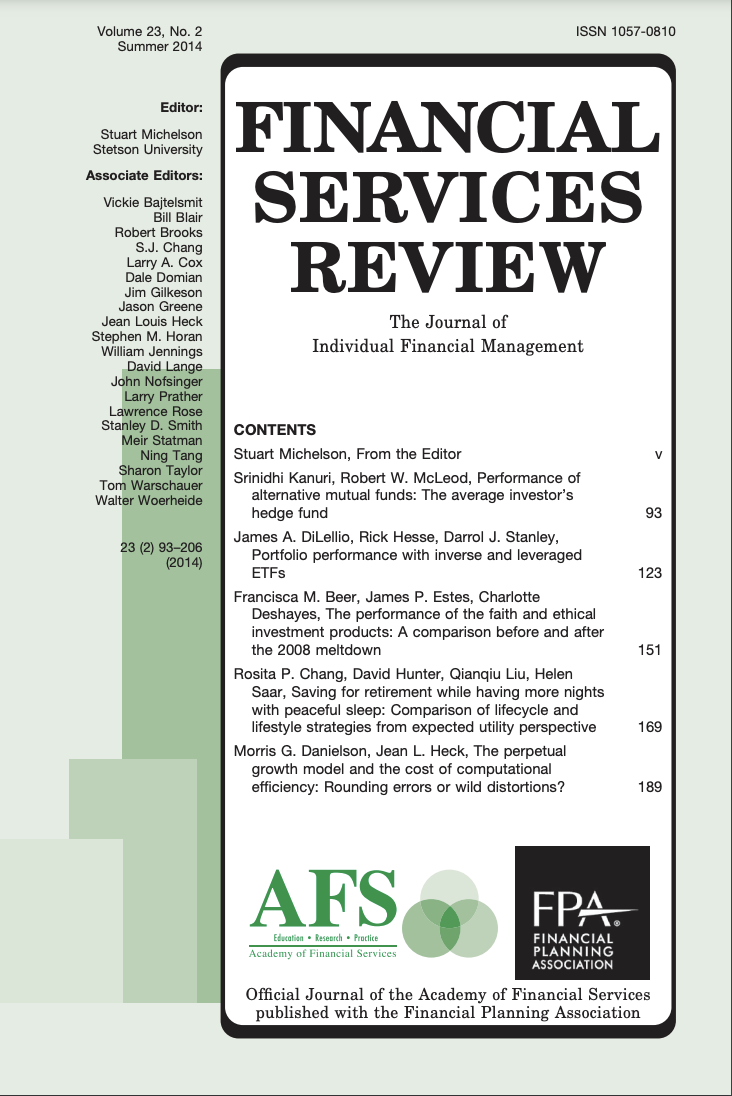
Performance of alternative mutual funds
The average investor’s hedge fund
DOI:
https://doi.org/10.61190/fsr.v23i2.3129Keywords:
Alternative investments, Mutual fund performance, Hedge fundsAbstract
Alternative Mutual Funds (AMFs) provide the individual investor with the opportunity to invest in funds that follow strategies similar to those of hedge funds and seek returns uncorrelated with the market. Financial planners, advisors, and investors need to be aware of how well AMFs deliver absolute or positive returns regardless of market conditions and their relatively high expense ratios. In this article we analyze the performance of AMFs for the period January 1998 through December 2011 using the Carhart four-factor model and the Fung-Hsieh seven-factor model. Our results indicate that most AMFs have not been able to create any value for their investors over the period of our study. Furthermore, the performance of these funds was even worse during the recent financial crisis. © 2014 Academy of Financial Services. All rights reserved.
Downloads
Downloads
Published
Issue
Section
License

This work is licensed under a Creative Commons Attribution-NonCommercial 4.0 International License.
Author(s) retain the copyright and full publishing rights without restriction.
Author(s) grant the Journal right of first publication with the work simultaneously licensed under a Creative Commons Attribution-NonCommercial 4.0 International License that allows reusers to distribute, remix, adapt, and build upon the material in any medium or format, for noncommercial purposes only. Reusers must acknowledge the work's authorship and initial publication in this Journal.
Noncommercial means not primarily intended for or directed towards commercial advantage or monetary compensation.
In addition, FSR grants to the UGA Libraries a worldwide, non-exclusive license to all content published by the Journal, including metadata, that is necessary to publish, transmit, and index the Journal and to preserve its content over time.