
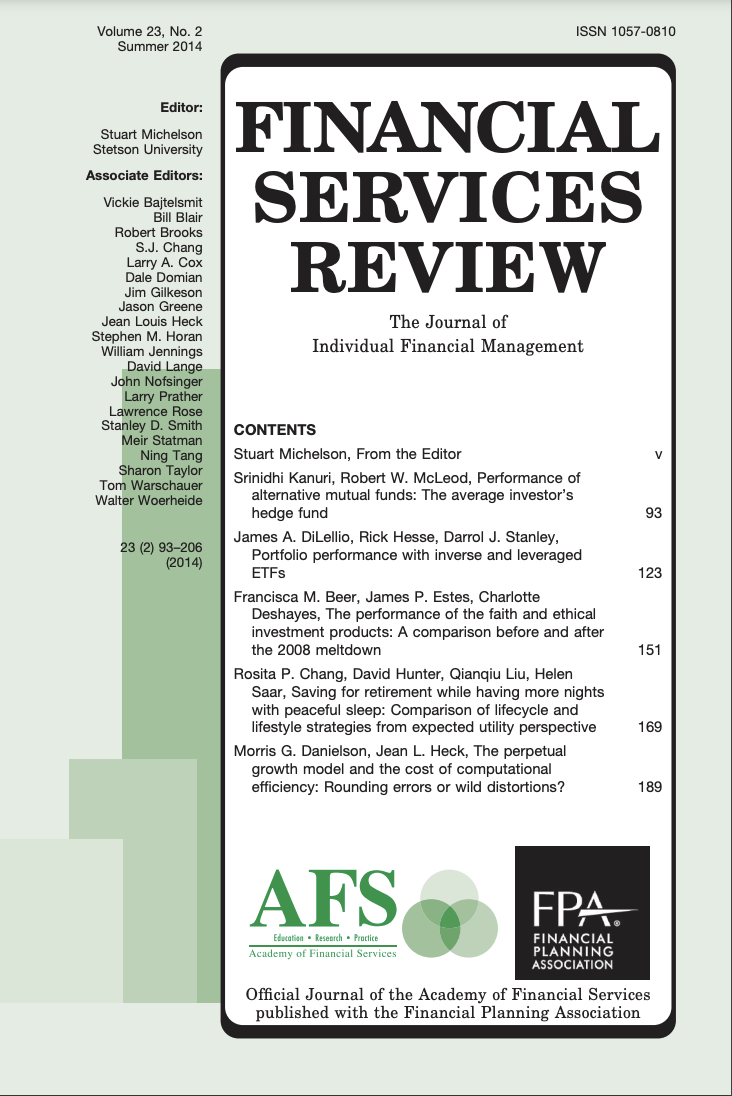
Saving for retirement while having more nights with peaceful sleep
Comparison of lifecycle and lifestyle strategies from expected utility perspective
DOI:
https://doi.org/10.61190/fsr.v23i2.3132Keywords:
Retirement saving, Target-date funds, Life cycle investingAbstract
We evaluate the fit of target-date funds (TDFs) as the main retirement savings instrument for the utility-maximizing investor who becomes more risk averse as she gets older. Using bootstrapping simulations, we show that TDFs can provide higher expected utility than the alternative lifestyle strategies. With loss aversion incorporated in the model, we still find that the optimal lifecycle strategy over time leads to higher expected utility than the best lifestyle strategy. Therefore, TDFs are preferable to the utility-maximizing investor. However, lifecycle strategies are not one-size-fits-all solution and investor’s risk tolerance has to be considered when selecting TDF funds.
Downloads
Downloads
Published
Issue
Section
License
Copyright (c) 2014 Academy of Financial Services

This work is licensed under a Creative Commons Attribution-NonCommercial 4.0 International License.
Author(s) retain the copyright and full publishing rights without restriction.
Author(s) grant the Journal right of first publication with the work simultaneously licensed under a Creative Commons Attribution-NonCommercial 4.0 International License that allows reusers to distribute, remix, adapt, and build upon the material in any medium or format, for noncommercial purposes only. Reusers must acknowledge the work's authorship and initial publication in this Journal.
Noncommercial means not primarily intended for or directed towards commercial advantage or monetary compensation.
In addition, FSR grants to the UGA Libraries a worldwide, non-exclusive license to all content published by the Journal, including metadata, that is necessary to publish, transmit, and index the Journal and to preserve its content over time.