
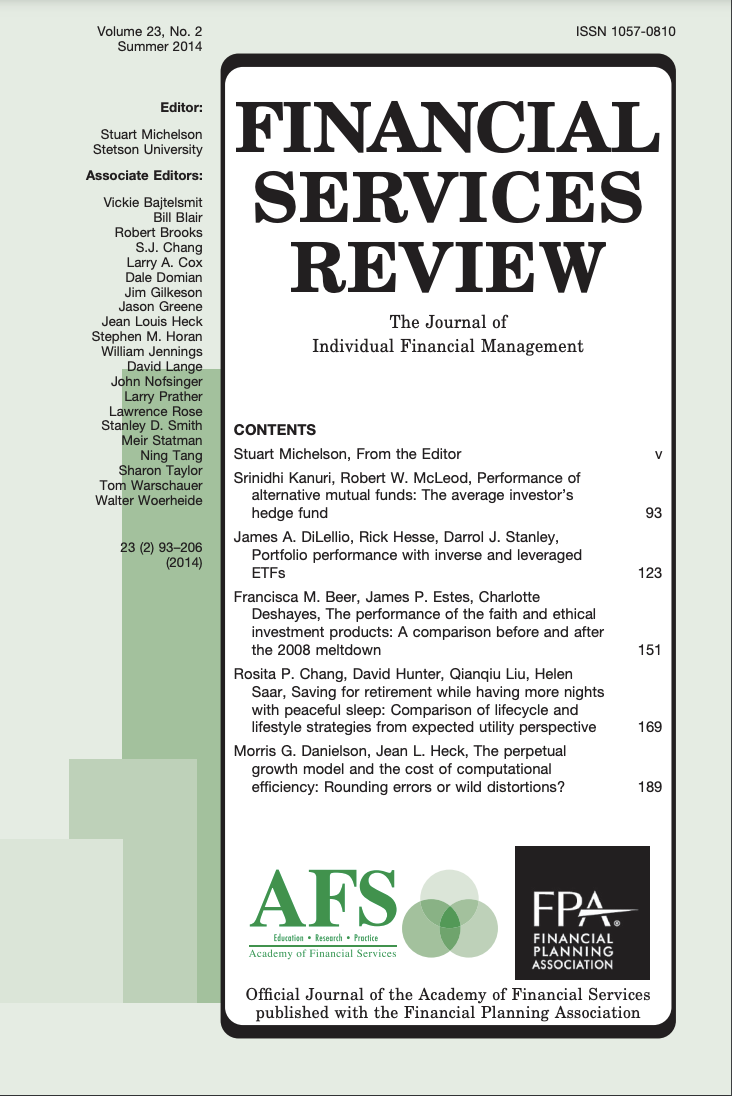
The perpetual growth model and the cost of computational efficiency
Rounding errors or wild distortions?
DOI:
https://doi.org/10.61190/fsr.v23i2.3134Keywords:
Stock valuation, Perpetual growth, Constant growth modelAbstract
The constant growth model (Gordon, 1962) plays an important role in the stock selection process for individual investors, in part, because of its computational simplicity. However, value estimates from the model can be highly dependent on cash flows to be received in the distant future. If future events might constrain a firm’s growth or lead to its demise, the unadjusted Gordon model can substantially overstate value. Because the model is less likely to misstate value for low-growth, high-payout firms, the ironic implication is that the model is most useful when its ability to value growth is needed least.
Downloads
Downloads
Published
Issue
Section
License
Copyright (c) 2014 Academy of Financial Services

This work is licensed under a Creative Commons Attribution-NonCommercial 4.0 International License.
Author(s) retain the copyright and full publishing rights without restriction.
Author(s) grant the Journal right of first publication with the work simultaneously licensed under a Creative Commons Attribution-NonCommercial 4.0 International License that allows reusers to distribute, remix, adapt, and build upon the material in any medium or format, for noncommercial purposes only. Reusers must acknowledge the work's authorship and initial publication in this Journal.
Noncommercial means not primarily intended for or directed towards commercial advantage or monetary compensation.
In addition, FSR grants to the UGA Libraries a worldwide, non-exclusive license to all content published by the Journal, including metadata, that is necessary to publish, transmit, and index the Journal and to preserve its content over time.