Financial teaching by parents and financial education at school or workplace
Evidence from Japan
DOI:
https://doi.org/10.61190/fsr.v30i4.3162Keywords:
Financial behavior, Financial education, Financial literacyAbstract
This study investigates the differential roles of financial socialization within the family versus fi- nancial education at school or the workplace, using data from a representative sample of 25,000 Japanese individuals. The results indicate that different platforms may play different roles. While the adults’ short-term financial behaviors, which involve regular feedback and immediate consequences for deviation, are primarily related to their parent’s financial advising in childhood, long-term finan- cial behaviors, which require complex planning and decision-making, are primarily related to finan- cial education received at school or the workplace. The results also suggest the benefits of accumulating financial experiences and education in different stages.
Downloads
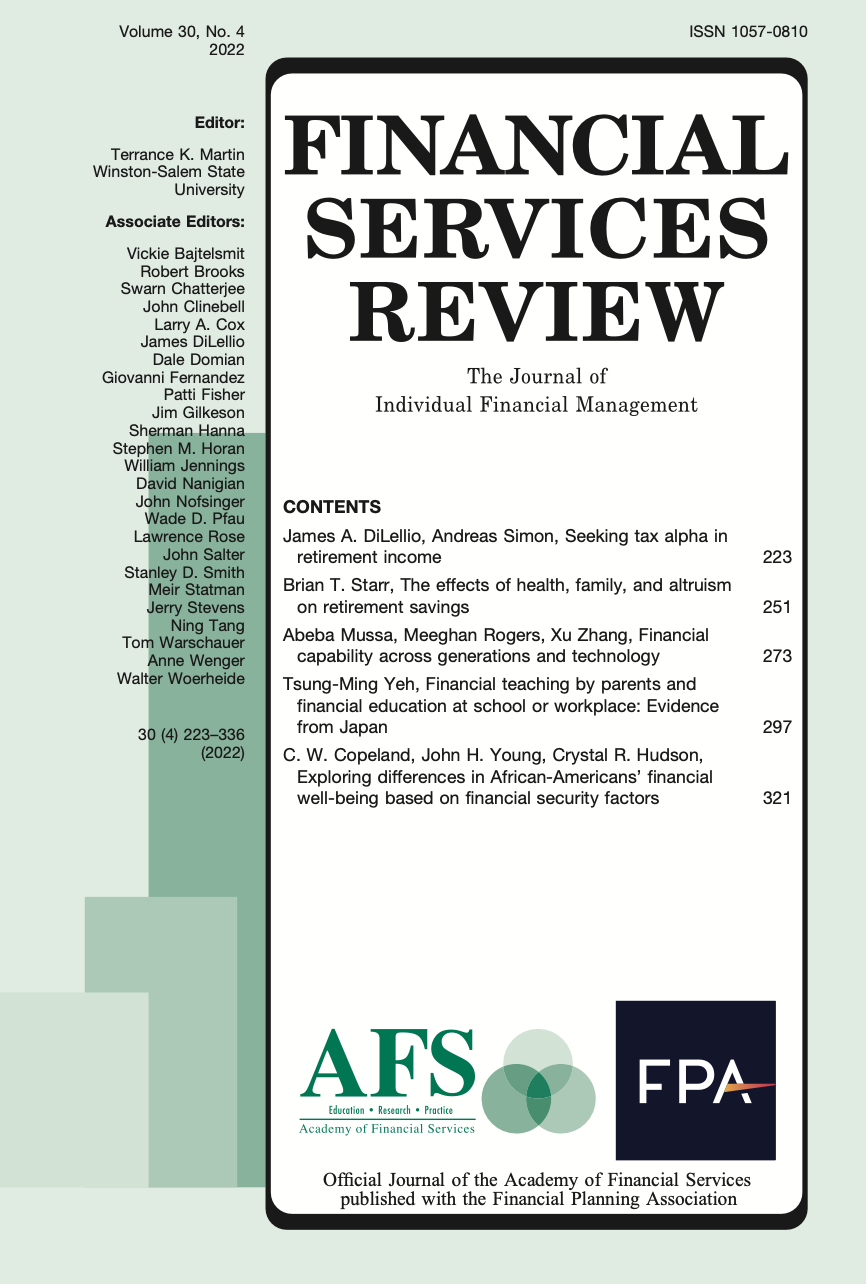
Downloads
Published
Issue
Section
License
Copyright (c) 2022 Tsung-Ming Yeh

This work is licensed under a Creative Commons Attribution-NonCommercial 4.0 International License.
Author(s) retain the copyright and full publishing rights without restriction.
Author(s) grant the Journal right of first publication with the work simultaneously licensed under a Creative Commons Attribution-NonCommercial 4.0 International License that allows reusers to distribute, remix, adapt, and build upon the material in any medium or format, for noncommercial purposes only. Reusers must acknowledge the work's authorship and initial publication in this Journal.
Noncommercial means not primarily intended for or directed towards commercial advantage or monetary compensation.
In addition, FSR grants to the UGA Libraries a worldwide, non-exclusive license to all content published by the Journal, including metadata, that is necessary to publish, transmit, and index the Journal and to preserve its content over time.