
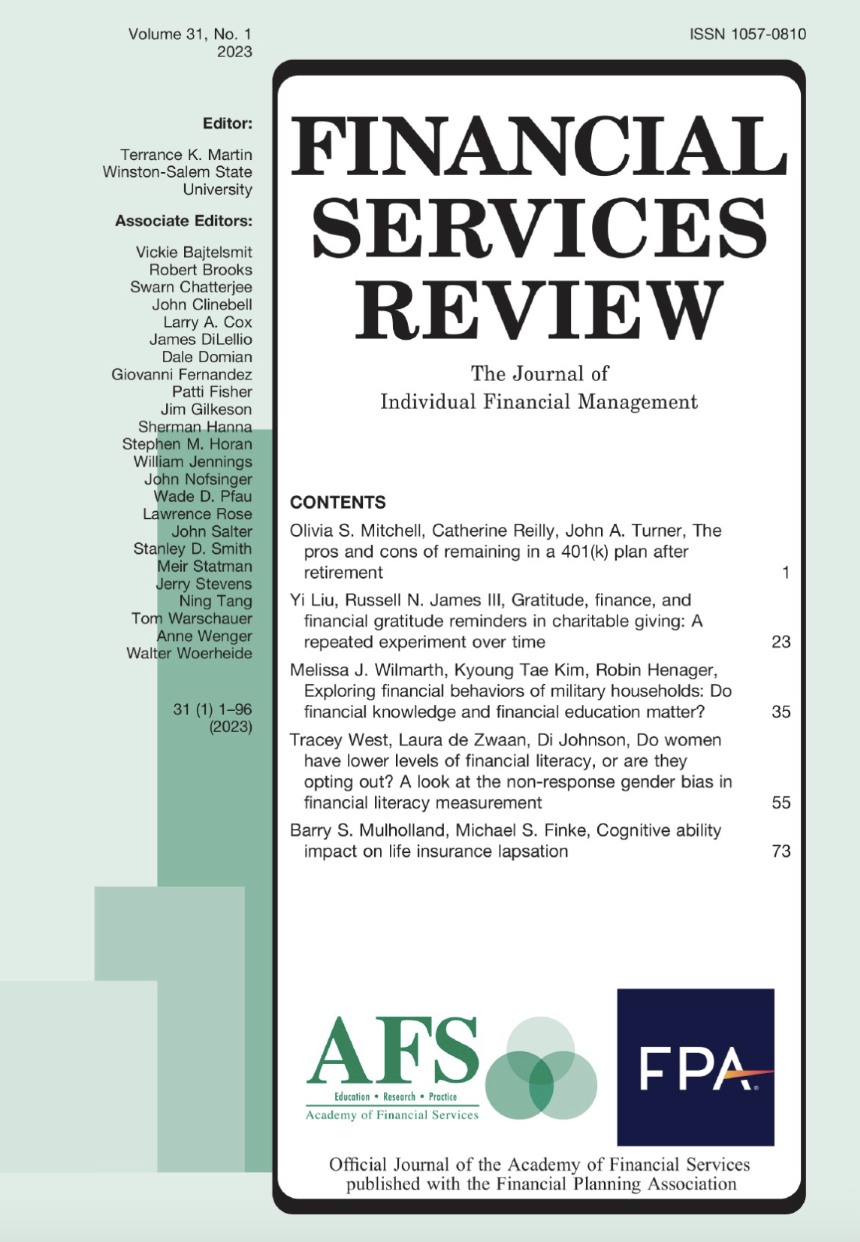
Do women have lower levels of financial literacy, or are they opting out?
A look at the non-response gender bias in financial literacy measurement
DOI:
https://doi.org/10.61190/fsr.v31i1.3195Keywords:
Financial literacy education, Measurement bias, Gender studies, Women, Financial literacyAbstract
Men consistently appear to outperform women on standard financial literacy tests. However, could the results be because of inherent gender bias in measurement tools? This study investigates the reasons for women selecting the non-response option in financial literacy questions, including numerical self-efficacy, risk aversion, and confidence. Our analysis finds evidence that women an- swer more questions than men utilizing the non-response option. A sustained lack of confidence with financial information is the primary reason. These results are important for shaping policy and providing resources that close the gap in measurement and ability.
Downloads
Downloads
Published
Issue
Section
License
Copyright (c) 2023 Tracey West, Laura de Zwaan, Di Johnson

This work is licensed under a Creative Commons Attribution-NonCommercial 4.0 International License.
Author(s) retain the copyright and full publishing rights without restriction.
Author(s) grant the Journal right of first publication with the work simultaneously licensed under a Creative Commons Attribution-NonCommercial 4.0 International License that allows reusers to distribute, remix, adapt, and build upon the material in any medium or format, for noncommercial purposes only. Reusers must acknowledge the work's authorship and initial publication in this Journal.
Noncommercial means not primarily intended for or directed towards commercial advantage or monetary compensation.
In addition, FSR grants to the UGA Libraries a worldwide, non-exclusive license to all content published by the Journal, including metadata, that is necessary to publish, transmit, and index the Journal and to preserve its content over time.