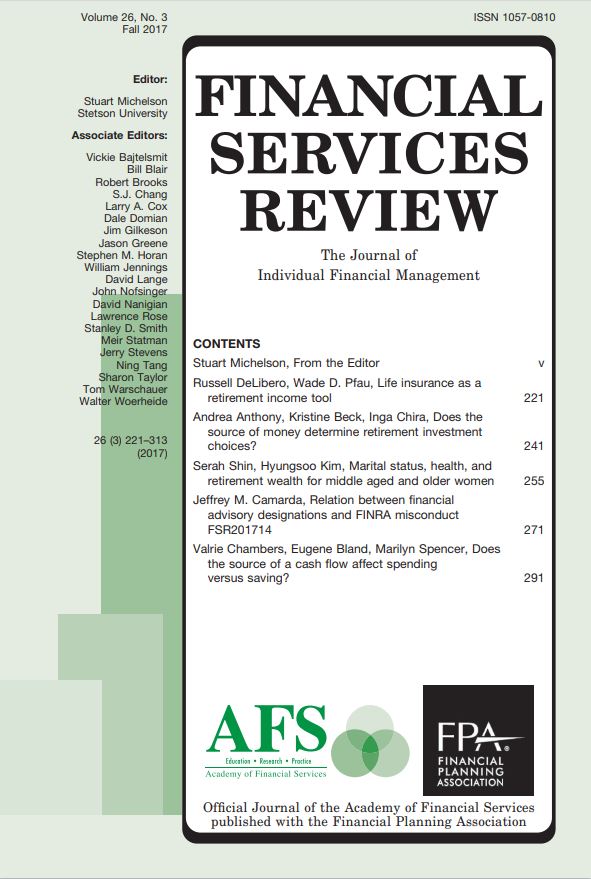
Does the source of a cash flow affect spending versus saving?
DOI:
https://doi.org/10.61190/fsr.v26i3.3324Keywords:
Income, Income source, Decision making, Consumer behavior, Mental accountingAbstract
This study examines whether people use different mental accounts for different types of hypothetical revenue windfalls rather than viewing them as fungible in their use consistent with neoclassical economics. This study finds that the income source sometimes influenced the amount spent/saved and a respondent’s general default as a spender or saver was highly significant in all regressions. This article adds to the literature by responding to Epley and Gneezy’s (2007) call for “a broader sample of participants, varying amounts of payment, and alternative frames” to identify moderators of windfall framing effects with implications for behavioral economic theory and financial planning.
Downloads
Downloads
Published
Issue
Section
License
Copyright (c) 2014 Academy of Financial Services

This work is licensed under a Creative Commons Attribution-NonCommercial 4.0 International License.
Author(s) retain the copyright and full publishing rights without restriction.
Author(s) grant the Journal right of first publication with the work simultaneously licensed under a Creative Commons Attribution-NonCommercial 4.0 International License that allows reusers to distribute, remix, adapt, and build upon the material in any medium or format, for noncommercial purposes only. Reusers must acknowledge the work's authorship and initial publication in this Journal.
Noncommercial means not primarily intended for or directed towards commercial advantage or monetary compensation.
In addition, FSR grants to the UGA Libraries a worldwide, non-exclusive license to all content published by the Journal, including metadata, that is necessary to publish, transmit, and index the Journal and to preserve its content over time.