
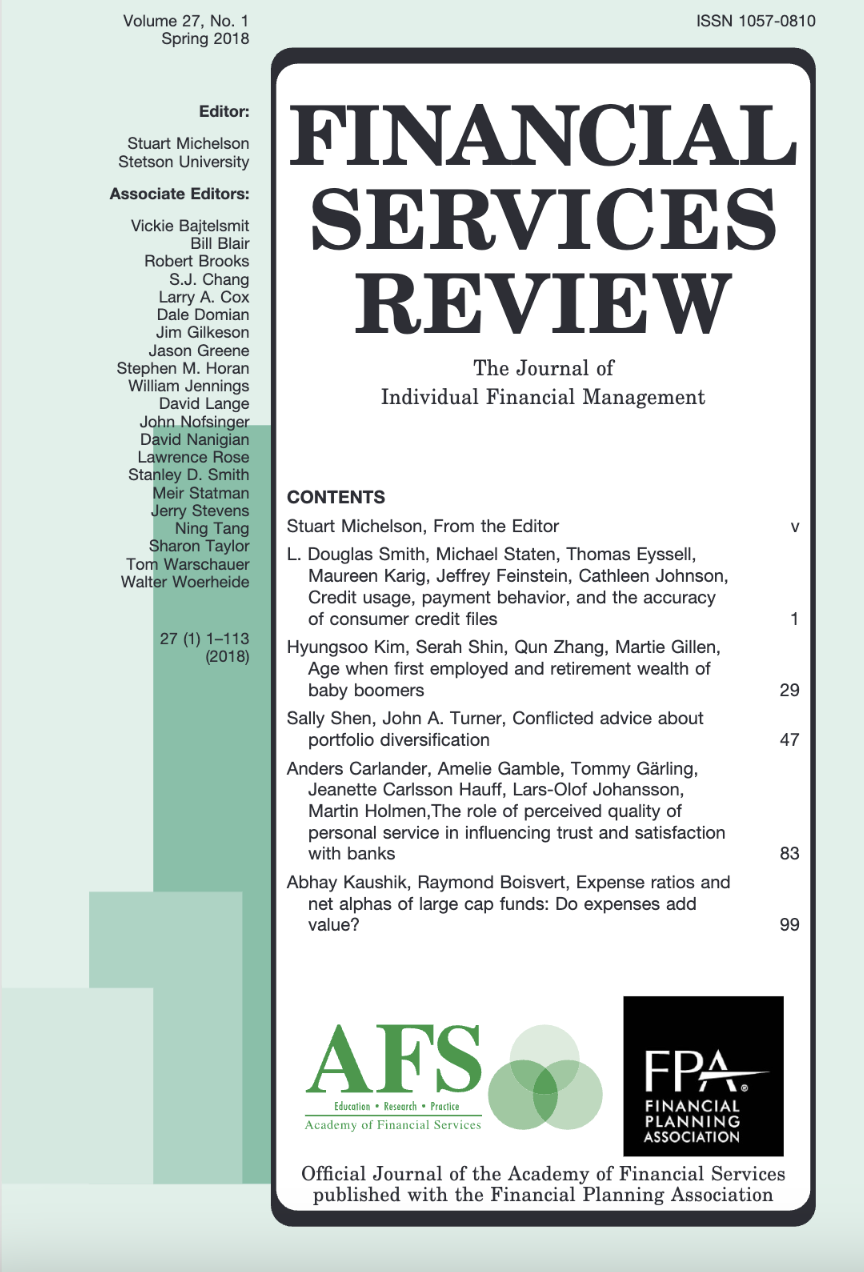
Age when first employed and retirement wealth of baby boomers
DOI:
https://doi.org/10.61190/fsr.v27i1.3379Keywords:
Young adults, Baby boomers, Timing of employment, Retirement savingsAbstract
This study examines how age when first employed is related to retirement savings in later years. Using data from the Health and Retirement Study, we investigate two specific questions: Has age when first employed affected the retirement wealth of baby boomers? If so, to what extent? The results show that age when first employed is negatively associated with accumulated retirement wealth in later years. For college graduates (high school graduates), delaying the start of employment cost $35,103 ($7,534) per year in retirement savings after controlling for demographic characteristics, number of working years, and occupation types.
Downloads
Downloads
Published
Issue
Section
License
Copyright (c) 2018 Academy of Financial Services

This work is licensed under a Creative Commons Attribution-NonCommercial 4.0 International License.
Author(s) retain the copyright and full publishing rights without restriction.
Author(s) grant the Journal right of first publication with the work simultaneously licensed under a Creative Commons Attribution-NonCommercial 4.0 International License that allows reusers to distribute, remix, adapt, and build upon the material in any medium or format, for noncommercial purposes only. Reusers must acknowledge the work's authorship and initial publication in this Journal.
Noncommercial means not primarily intended for or directed towards commercial advantage or monetary compensation.
In addition, FSR grants to the UGA Libraries a worldwide, non-exclusive license to all content published by the Journal, including metadata, that is necessary to publish, transmit, and index the Journal and to preserve its content over time.