
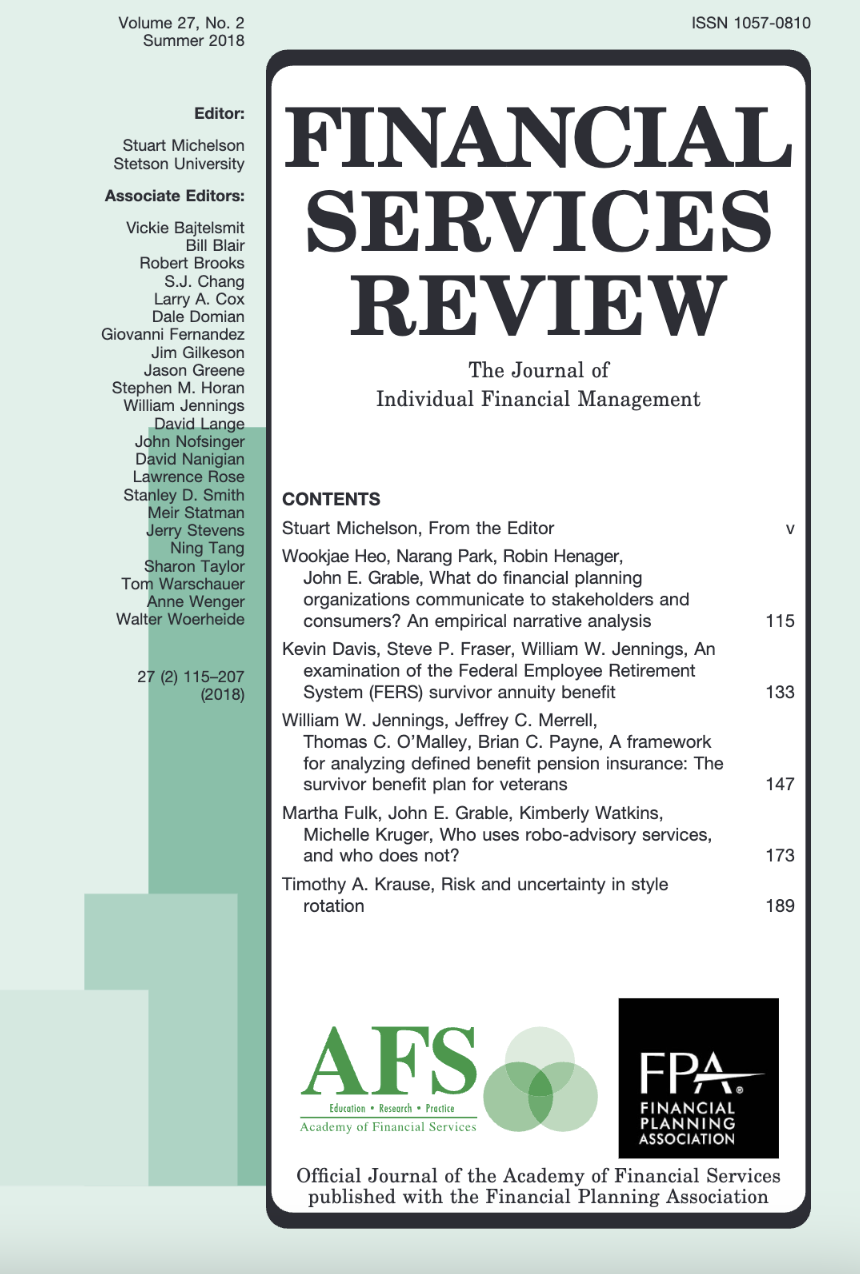
Risk and uncertainty in style rotation
DOI:
https://doi.org/10.61190/fsr.v27i2.3391Keywords:
Style returns, Value versus growth, Uncertainty, ETF, Exchange traded fund, Volatility, VVIX index, VIX indexAbstract
The Chicago Board Options Exchange (CBOE VIX; volatility) index has been established as a leading indicator of style returns since increases in this “fear index” lead to outperformance of “value” versus “growth” stocks. This study introduces the concept of “uncertainty” as an additional indicator of returns to value, as measured by the CBOE VVIX (“volatility of volatility”). This index is considered to be a proxy for “uncertainty” in the Knightian sense. Increases in expected volatility lead to short-term positive returns to value, while increases in uncertainty lead to negative short-term returns to value. Each of these observations are especially strong during economic downturns and after decreases in the VIX index. Several macroeconomic indicators provide additional incremental infor- mation regarding these phenomena.
Downloads
Downloads
Published
Issue
Section
License
Copyright (c) 2018 Academy of Financial Services

This work is licensed under a Creative Commons Attribution-NonCommercial 4.0 International License.
Author(s) retain the copyright and full publishing rights without restriction.
Author(s) grant the Journal right of first publication with the work simultaneously licensed under a Creative Commons Attribution-NonCommercial 4.0 International License that allows reusers to distribute, remix, adapt, and build upon the material in any medium or format, for noncommercial purposes only. Reusers must acknowledge the work's authorship and initial publication in this Journal.
Noncommercial means not primarily intended for or directed towards commercial advantage or monetary compensation.
In addition, FSR grants to the UGA Libraries a worldwide, non-exclusive license to all content published by the Journal, including metadata, that is necessary to publish, transmit, and index the Journal and to preserve its content over time.