
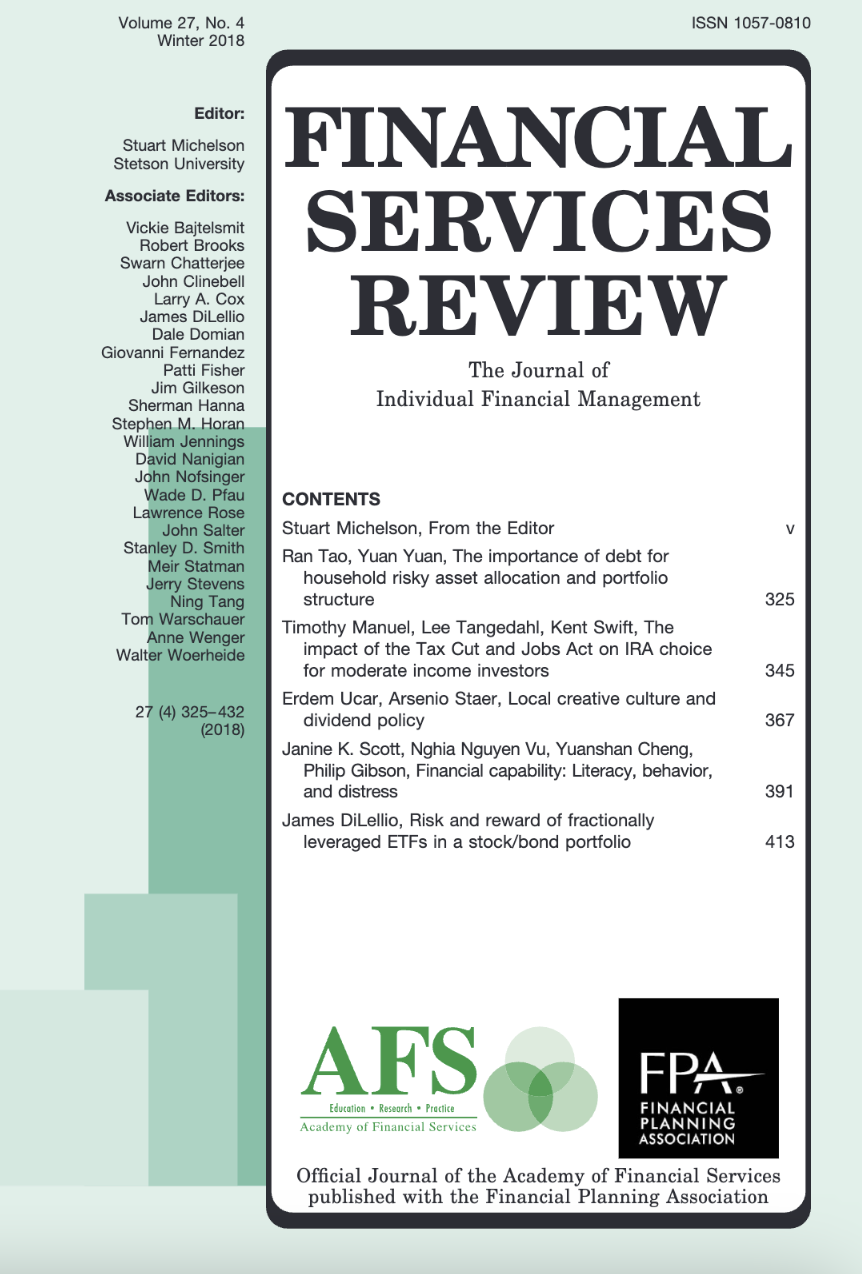
The importance of debt for household risky asset allocation and portfolio structure
DOI:
https://doi.org/10.61190/fsr.v27i4.3403Keywords:
Debt structure, Secured debt, Risky asset investment, Financial asset allocationAbstract
When households decide on risky asset holdings, they do not make the decision in isolation from their debt structure and obligations, vice versa. We examine the joint behavior of debt and financial asset portfolio decisions, while existing empirical research on debt and asset portfolio choices has proceeded separately. In this paper, we first test the relationship between debt structure and asset allocation, then estimate the determinants of debt structure and asset allocation simultaneously. Using the 2016 Survey of Consumer Finances (SCF) data, we find robust evidence that debt structure affects households’ risky asset allocation decisions and identify, in this simultaneous decision-making process, the demographic and financial factors that can contribute to the household overall financial portfolio structure.
Downloads
Downloads
Published
Issue
Section
License
Copyright (c) 2018 Academy of Financial Services

This work is licensed under a Creative Commons Attribution-NonCommercial 4.0 International License.
Author(s) retain the copyright and full publishing rights without restriction.
Author(s) grant the Journal right of first publication with the work simultaneously licensed under a Creative Commons Attribution-NonCommercial 4.0 International License that allows reusers to distribute, remix, adapt, and build upon the material in any medium or format, for noncommercial purposes only. Reusers must acknowledge the work's authorship and initial publication in this Journal.
Noncommercial means not primarily intended for or directed towards commercial advantage or monetary compensation.
In addition, FSR grants to the UGA Libraries a worldwide, non-exclusive license to all content published by the Journal, including metadata, that is necessary to publish, transmit, and index the Journal and to preserve its content over time.