
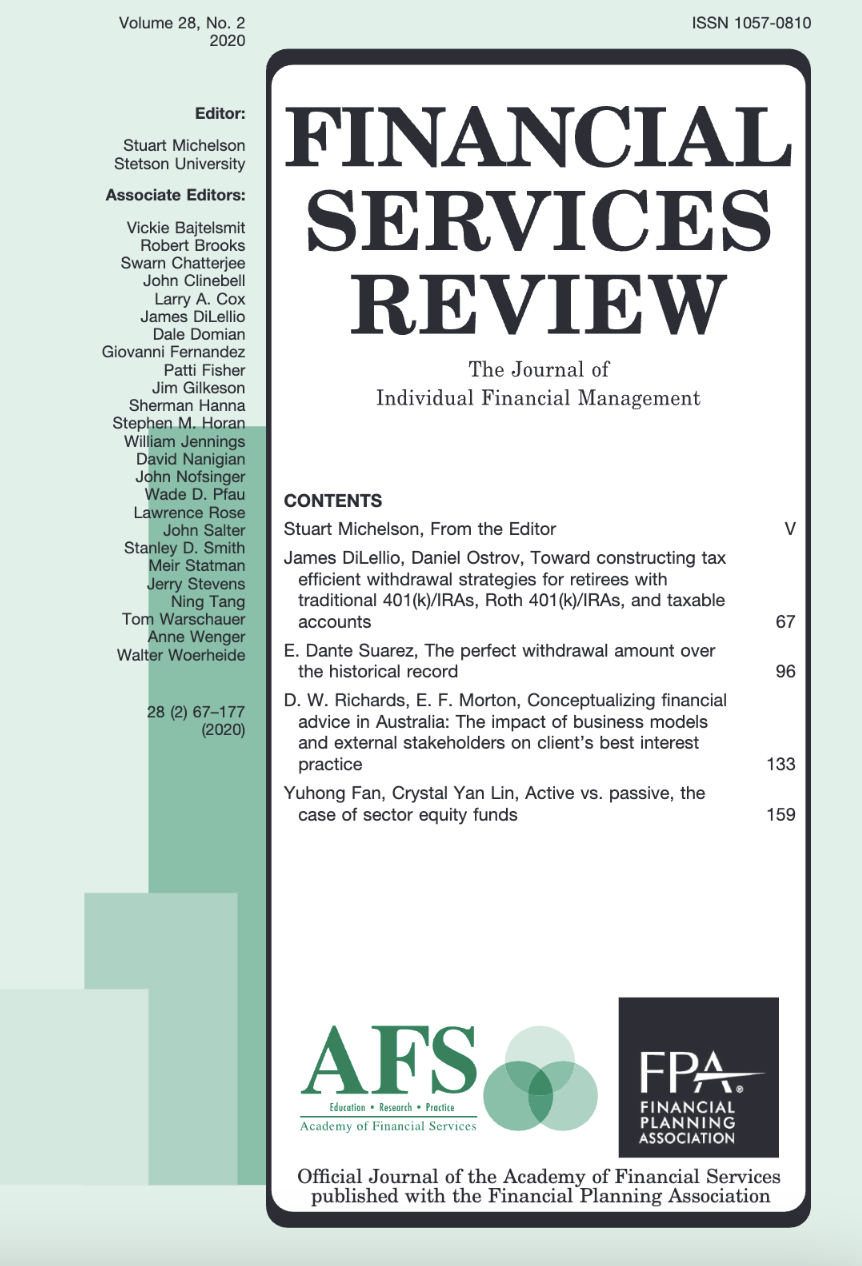
The perfect withdrawal amount over the historical record
DOI:
https://doi.org/10.61190/fsr.v28i2.3420Keywords:
Distribution strategies, Sustainable withdrawal rate, Sequencing risk, Perfect withdrawal amount, Retirement incomeAbstract
What has been the perfect withdrawal amount (PWA) from retirement savings accounts in long- term historical data? The PWA is that which, if taken out in the first year of retirement and used again every year adjusted by inflation, leaves exactly the desired final balance on the account. We present the formula for obtaining this measure and evaluate the values it has taken in the past under varying combi- nations of the relevant parameters. We find that safety-minded investors should enter retirement with a higher stock allocation than what is currently used in most investment funds designed to provide income during retirement.
Downloads
References
Basu, A. K., Byrne, A., & Drew, M. E. (2011). Dynamic lifecycle strategies for target date retirement funds. The Journal of Portfolio Management, 37, 83-96 https://doi.org/10.3905/jpm.2011.37.2.083 DOI: https://doi.org/10.3905/jpm.2011.37.2.083
Bengen, W. P. (1994). Determining withdrawal rates using historical data. Journal of Financial Planning, 7, 171-180.
Bierwirth, L. (1994). Investing for retirement: using the past to model the future. Journal of Financial Planning, 7, 14-24.
Blanchett, D. M., & Frank, L. R. (2009). A dynamic and adaptive approach to distribution planning and monitoring. Journal of Financial Planning, 22, 52-66.
Bridges, B., & Choudhury, S. (2007). Social security benefits as a retirement resource for U.S. near-retirees. Review of Income and Wealth, 53, 538-567. https://doi.org/10.1111/j.1475-4991.2007.00238.x DOI: https://doi.org/10.1111/j.1475-4991.2007.00238.x
Charles Schwab Investment Management, Inc. (2015). Schwab Monthly Income Funds: Three Diversified Income Solutions (available at http://ims.schwab.wallst.com/repository/?doc=SchwabMonthlyIncomeFundsSalesSheet).
Clare, A., Seaton, J., Smith, P. N., & Thomas, S. (2016a). Reducing sequence risk using trend following investment strategies and the CAPE. Discussion Papers in Economics. University of York, 16, 11.
Clare, A., Seaton, J., Smith, P. N., & Thomas, S. (2016b). The trend is our friend: risk parity, momentum and trend following in global asset allocation. Journal of Behavioral and Experimental Finance, 9, 63-80. https://doi.org/10.1016/j.jbef.2016.01.002 DOI: https://doi.org/10.1016/j.jbef.2016.01.002
Coile, C., & Milligan, K. (2009). How household portfolios evolve after retirement: the effect of aging and health shocks. Review of Income and Wealth, 55, 226-248. https://doi.org/10.1111/j.1475-4991.2009.00320.x DOI: https://doi.org/10.1111/j.1475-4991.2009.00320.x
Cooley, P. L., Hubbard, C. M., & Walz, D. T. (1998). Retirement savings: choosing a withdrawal rate that is sustainable. Journal of the American Association of Individual Investors, 20, 16-21.
Cooley, P. L., Hubbard, C. M., & Walz, D. T. (1999). Sustainable withdrawal rates from your retirement portfolio. Financial Counseling and Planning, 10, 39-47.
Cooley, P. L., Hubbard, C. M., & Walz, D. T. (2003). A comparative analysis of retirement portfolio success rates: simulation versus overlapping periods. Financial Services Review, 12, 115-129. https://doi.org/10.61190/fsr.v12i2.4759 DOI: https://doi.org/10.61190/fsr.v12i2.4759
Cooley, P. L., Hubbard, C. M., & Walz, D. T. (2011). Portfolio success rates: where to draw the line. Journal of Financial Planning, 24, 48-60.
Estrada, J. (2018). Maximum withdrawal rates: an empirical and global perspective. The Journal of Retirement, 5, 57-71. https://doi.org/10.3905/jor.2018.2018.1.035 DOI: https://doi.org/10.3905/jor.2018.2018.1.035
Fidelity Investments, Inc. (2015). Fidelity Income Replacement Funds: At-A-Glance (available at http://personal.fidelity.com/myfidelity/InsideFidelity/NewsCenter/mediadocs/firf_at_a_ glance.pdf).
Frank, L. R., Mitchell, J. B., & Blanchett, D. (2011). Probability-of-failure-based decision rules to manage sequence risk in retirement. Journal of Financial Planning, 24, 44-53.
Guyton, J. T., & Klinger, W. J. (2006). Decision rules and maximum initial withdrawal rates. Journal of Financial Planning, 19, 49-57.
Ibbotson, R. G., & Sinquefield, R. A. (1976). Stocks, bonds, bills, and inflation: year-by-year historical returns (1926-1974). The Journal of Business, 49, 11-47. https://doi.org/10.1086/295803 DOI: https://doi.org/10.1086/295803
Ibbotson, S. B. B. I. (2015). Classic Yearbook: Market Results for 1926-2014.
John Hancock Funds, LLC. (2016). Asset Allocation: Redefining Diversification in Your Portfolio (available at http://www.jhinvestments.com/CMS/Downloadableitems/educationandguidance/p_PIAABR-RL.pdf).
Mitchell, J. B. (2011). Retirement withdrawals: preventive reductions and risk management. Financial Services Review, 20, 45-59. https://doi.org/10.61190/fsr.v20i1.4690 DOI: https://doi.org/10.61190/fsr.v20i1.4690
Morningstar Inc. (2015). 2015 Ibbotson Stocks, Bonds, Bills, and Inflation (SBBI) Classic Yearbook. Chicago, IL: Morningstar Inc.
Pye, G. B. (2000). Sustainable investment withdrawals. The Journal of Portfolio Management, 26, 73-83. https://doi.org/10.3905/jpm.2000.319765 DOI: https://doi.org/10.3905/jpm.2000.319765
Social Security Administration. (2016). Calculators: Life Expectancy (available at https://www.ssa.gov/planners/lifeexpectancy.html).
Spitzer, J. J. (2008). Retirement withdrawals: an analysis of the benefits of periodic 'midcourse' adjustments. Financial Services Review, 17, 17-29. https://doi.org/10.61190/fsr.v17i1.4903 DOI: https://doi.org/10.61190/fsr.v17i1.4903
Stout, R. G. (2008). Stochastic optimization of retirement portfolio asset allocations and withdrawals. Financial Services Review, 17, 1-15. https://doi.org/10.61190/fsr.v17i1.4902 DOI: https://doi.org/10.61190/fsr.v17i1.4902
Stout, R. G., & Mitchell, J. B. (2006). Dynamic retirement withdrawal planning. Financial Services Review, 15, 117-131. https://doi.org/10.61190/fsr.v15i2.4851 DOI: https://doi.org/10.61190/fsr.v15i2.4851
Suarez, E. D., Suarez, A., & Walz, D. T. (2015). The perfect withdrawal amount: a methodology for creating retirement account distribution strategies. Financial Services Review, 24, 331-357. https://doi.org/10.61190/fsr.v24i4.3243 DOI: https://doi.org/10.61190/fsr.v24i4.3243
The Vanguard Group, Inc. (2016). Vanguard Managed Payout Fund (available at https://personal.vanguard.com/us/funds/snapshot?FundId=1498&FundIntExt= INT).
Waggle, D., & Englis, B. (2000). Asset allocation decisions in retirement accounts: an all-or-nothing proposition?. Financial Services Review, 9, 79-92. https://doi.org/10.1016/S1057-0810(00)00057-3 DOI: https://doi.org/10.1016/S1057-0810(00)00057-3
Waring, M. B., & Siegel, L. B. (2015). The only spending rule article you will ever need. Financial Analysts Journal, 71, 91-107. https://doi.org/10.2469/faj.v71.n1.2 DOI: https://doi.org/10.2469/faj.v71.n1.2
Zolt, D. M. (2013). Achieving a higher safe withdrawal rate with the target percentage adjustment. Journal of Financial Planning, 26, 51-59.
Downloads
Published
Issue
Section
License
Copyright (c) 2020 Academy of Financial Services

This work is licensed under a Creative Commons Attribution-NonCommercial 4.0 International License.
Author(s) retain the copyright and full publishing rights without restriction.
Author(s) grant the Journal right of first publication with the work simultaneously licensed under a Creative Commons Attribution-NonCommercial 4.0 International License that allows reusers to distribute, remix, adapt, and build upon the material in any medium or format, for noncommercial purposes only. Reusers must acknowledge the work's authorship and initial publication in this Journal.
Noncommercial means not primarily intended for or directed towards commercial advantage or monetary compensation.
In addition, FSR grants to the UGA Libraries a worldwide, non-exclusive license to all content published by the Journal, including metadata, that is necessary to publish, transmit, and index the Journal and to preserve its content over time.