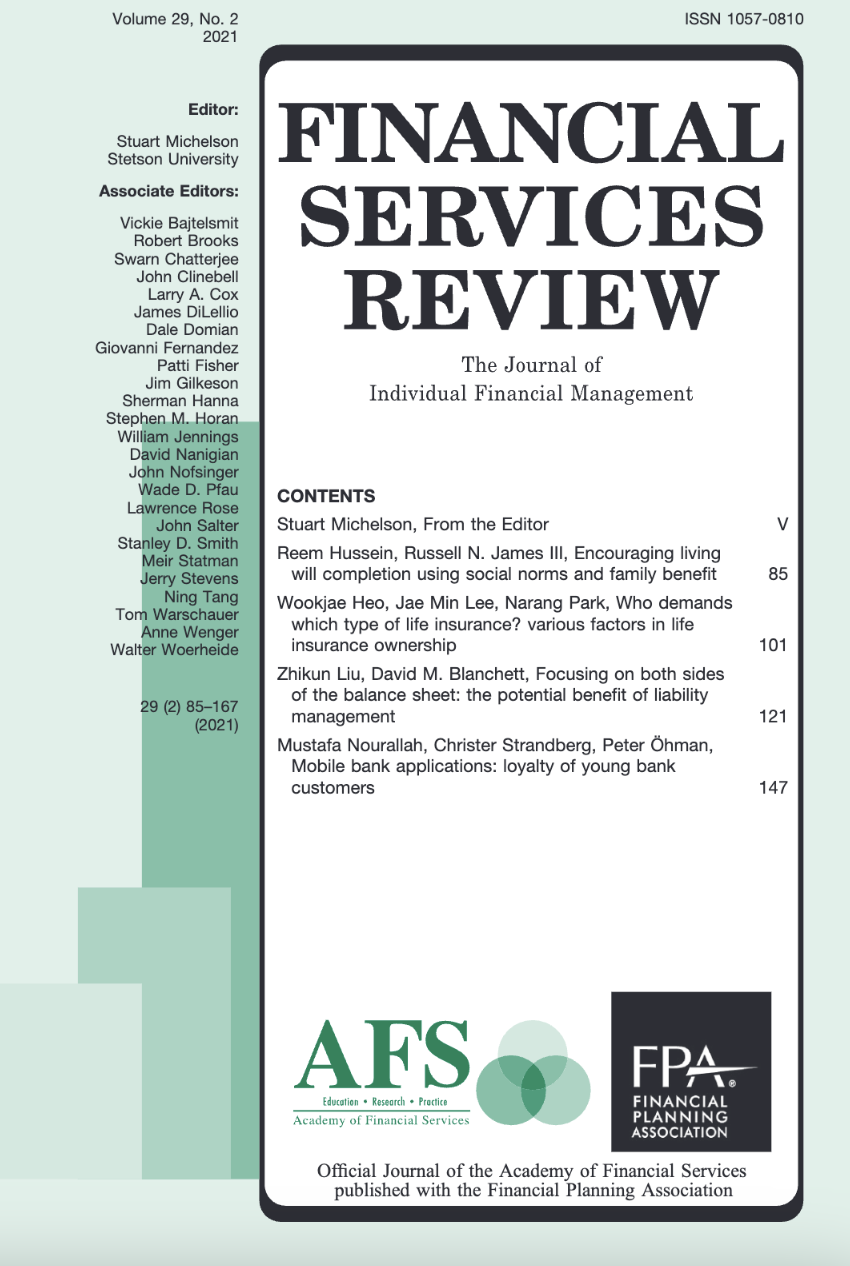
Focusing on both sides of the balance sheet
the potential benefit of liability management
DOI:
https://doi.org/10.61190/fsr.v29i2.3450Keywords:
Financial decision making, Behavioral finance, Retirement financial planning, Debt managementAbstract
Debt has become a significant issue among U.S. households with average household interest pay- ments on liabilities exceeding expected returns on investment assets by more than 50%. In this study, we explore the role of U.S. household debt and analyze the impact of different economic, demo- graphic, and behavioral factors on household borrowing decisions, with a particular focus on “good” and “bad” debts, which depend on type and interest rate. We estimate significant potential benefits with improved liability management and find that households with lower asset, income, and educa- tion levels are likely to benefit most from assistance with debt optimization.
Downloads
Downloads
Published
Issue
Section
License
Copyright (c) 2021 Academy of Financial Services

This work is licensed under a Creative Commons Attribution-NonCommercial 4.0 International License.
Author(s) retain the copyright and full publishing rights without restriction.
Author(s) grant the Journal right of first publication with the work simultaneously licensed under a Creative Commons Attribution-NonCommercial 4.0 International License that allows reusers to distribute, remix, adapt, and build upon the material in any medium or format, for noncommercial purposes only. Reusers must acknowledge the work's authorship and initial publication in this Journal.
Noncommercial means not primarily intended for or directed towards commercial advantage or monetary compensation.
In addition, FSR grants to the UGA Libraries a worldwide, non-exclusive license to all content published by the Journal, including metadata, that is necessary to publish, transmit, and index the Journal and to preserve its content over time.