
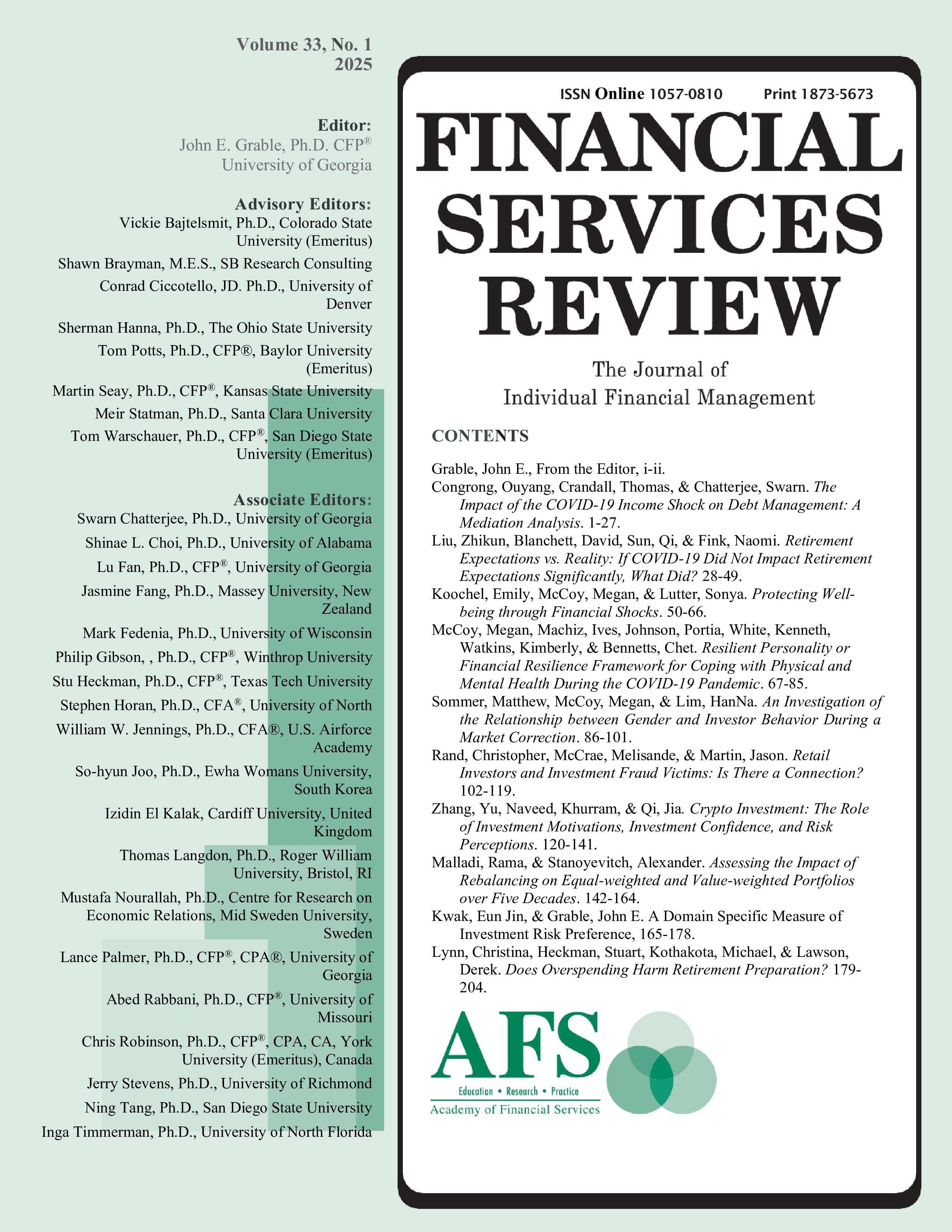
Assessing the Impact of Rebalancing on Equal-weighted and Value-weighted Portfolios over Five Decades
DOI:
https://doi.org/10.61190/fsr.v33i1.3991Keywords:
Active portfolio management, Investment portfolio, Diversified portfolios, Portfolio diversificationAbstract
This study investigates the impact of transaction costs on the performance differential between equal-weighted portfolios (EWPs) and value-weighted portfolios (VWPs). Employing a comprehensive dataset of 181 stocks from 1970 to 2023, we utilize paired two-sample tests to identify statistically significant differences in turnover and risk-adjusted returns. Our findings reveal a substantial performance advantage for EWPs, with annualized return surpluses ranging from 115 to 188 basis points over VWPs, depending on the assumed transaction cost level. Notably, this outperformance persists until transaction costs reach a critical threshold of 728 basis points of portfolio turnover. The analysis further demonstrates that EWPs outperform VWPs in 94.5% of scenarios devoid of transaction costs, declining to 84% when incorporating realistic cost assumptions. These results highlight the potential of EWPs to exploit diversification benefits but also emphasize the crucial role of transaction costs in moderating their outperformance.
Downloads
Downloads
Published
Issue
Section
License
Copyright (c) 2024 Rama Malladi, Alexander Stanoyevitch

This work is licensed under a Creative Commons Attribution-NonCommercial 4.0 International License.
Author(s) retain the copyright and full publishing rights without restriction.
Author(s) grant the Journal right of first publication with the work simultaneously licensed under a Creative Commons Attribution-NonCommercial 4.0 International License that allows reusers to distribute, remix, adapt, and build upon the material in any medium or format, for noncommercial purposes only. Reusers must acknowledge the work's authorship and initial publication in this Journal.
Noncommercial means not primarily intended for or directed towards commercial advantage or monetary compensation.
In addition, FSR grants to the UGA Libraries a worldwide, non-exclusive license to all content published by the Journal, including metadata, that is necessary to publish, transmit, and index the Journal and to preserve its content over time.