
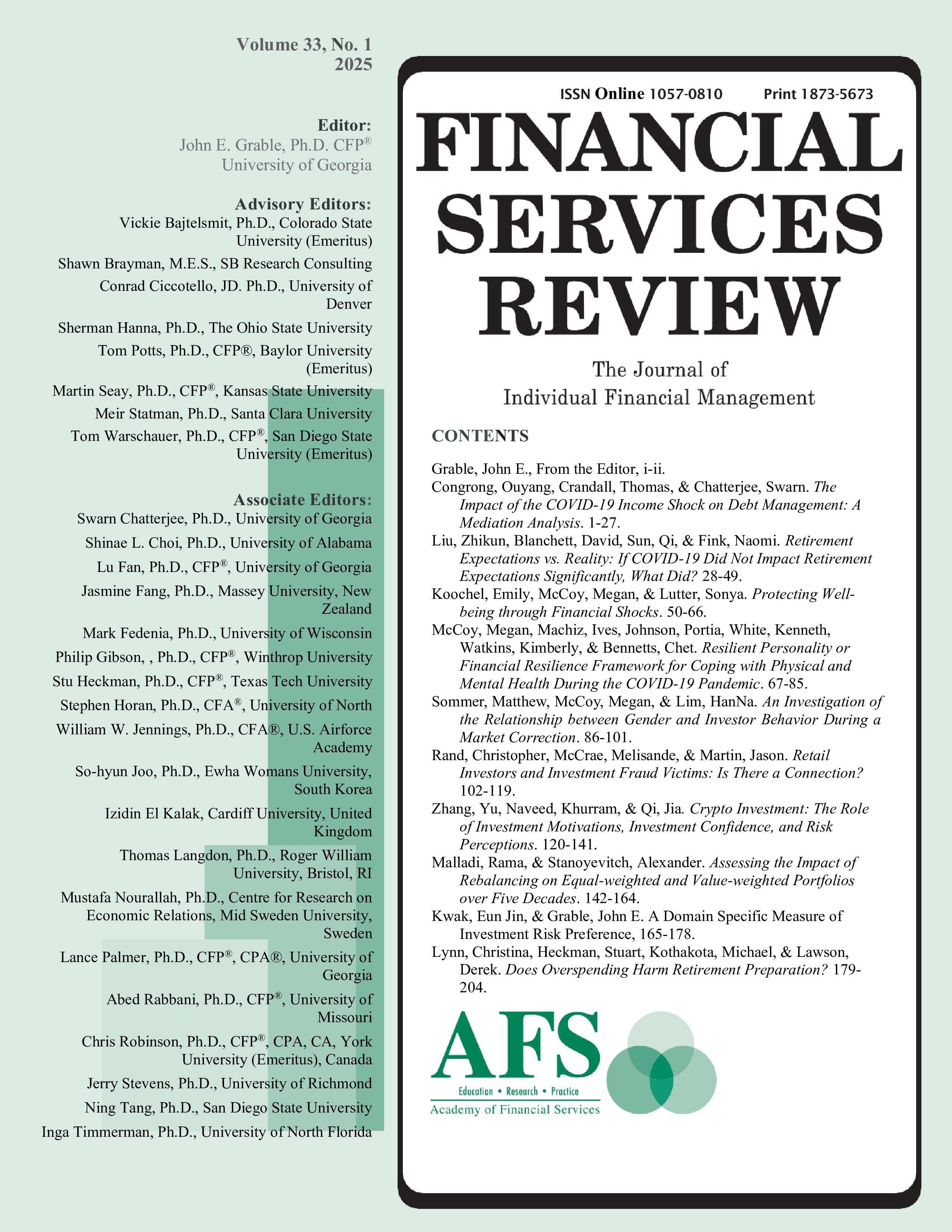
A Domain Specific Measure of Investment Risk Preference
DOI:
https://doi.org/10.61190/fsr.v33i1.4032Keywords:
Risk Preference, Risk Tolerance, Scale, Risk ScaleAbstract
This study introduces and validates a domain-specific investment risk-preference measure that integrates elements of revealed-preference tests, using choice scenario dyads, with stated-preference approaches that leverage individual experiences and perceptions. Data from two surveys were analyzed using OLS regression and ordered logit models to evaluate the measure’s efficacy. Results demonstrate that the proposed measure is positively associated with a modified version of the Survey of Consumer Finances (SCF) self-assessed risk-tolerance item and negatively associated with cash-holding behavior. Compared to existing risk-tolerance assessments, this measure offers a practical advantage by allowing financial advisors to align investment products more accurately with a test-taker’s risk-taking comfort level. This direct applicability highlights the measure's unique value in enhancing portfolio personalization and advancing the precision of investment risk assessment tools.
Downloads
Downloads
Published
Issue
Section
License
Copyright (c) 2024 Eun Jin Kwak; John Grable

This work is licensed under a Creative Commons Attribution-NonCommercial 4.0 International License.
Author(s) retain the copyright and full publishing rights without restriction.
Author(s) grant the Journal right of first publication with the work simultaneously licensed under a Creative Commons Attribution-NonCommercial 4.0 International License that allows reusers to distribute, remix, adapt, and build upon the material in any medium or format, for noncommercial purposes only. Reusers must acknowledge the work's authorship and initial publication in this Journal.
Noncommercial means not primarily intended for or directed towards commercial advantage or monetary compensation.
In addition, FSR grants to the UGA Libraries a worldwide, non-exclusive license to all content published by the Journal, including metadata, that is necessary to publish, transmit, and index the Journal and to preserve its content over time.