
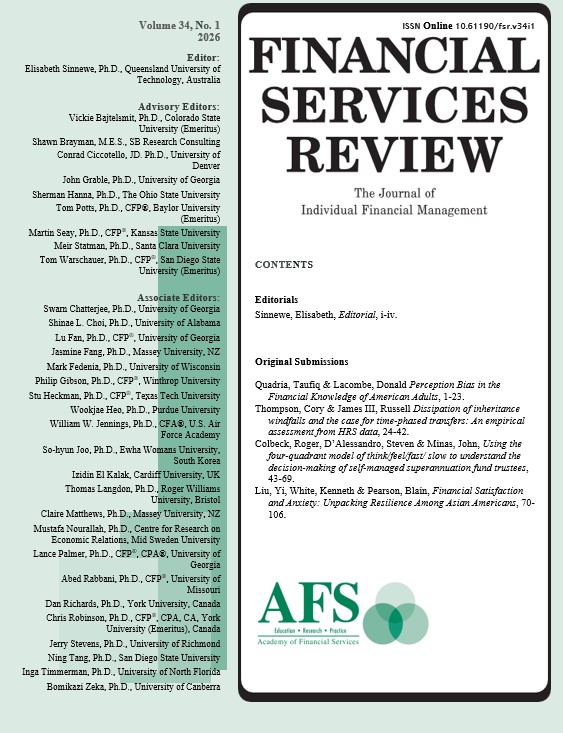
Using the Four-Quadrant Model of Think/Feel/Fast/ Slow to Understand the Decision-Making of Self-Managed Superannuation Fund Trustees
DOI:
https://doi.org/10.61190/zsy7wg09Abstract
This research focuses on decision-making by trustees of self-managed superannuation funds (SMSFs) in Australia. Behavioral attributes are examined using the four-quadrant model (FQM) developed by Lovric et al. (2010), comprising the cognitive, affective, controlled, and automatic quadrants. The FQM integrates two closely related dual‑process theories (DPT). Both the DPT framework and the FQM draw on foundational principles from the cognitive and behavioral sciences. The result of the mixed methods study uses the FQM to explain investment decision-making. The dataset was examined using cluster analysis to identify underlying group structures, followed by regression modelling to assess the relationships between key variables. The model can also predict trustees who seek investment advice and those who act independently. The FQM was also associated with different styles of investment decision-making by the SMSF trustees and investors. Under the model, trustees and investors are classified as active or passive investors. A key finding of the research is that investment decision-making often includes emotions and feelings as overriding influences, and nonrational behavior can and does determine investment decisions.
Downloads
Downloads
Published
Issue
Section
License
Copyright (c) 2026 Roger Colbeck, Steven D'Alessandro, John Minas

This work is licensed under a Creative Commons Attribution-NonCommercial 4.0 International License.
Author(s) retain the copyright and full publishing rights without restriction.
Author(s) grant the Journal right of first publication with the work simultaneously licensed under a Creative Commons Attribution-NonCommercial 4.0 International License that allows reusers to distribute, remix, adapt, and build upon the material in any medium or format, for noncommercial purposes only. Reusers must acknowledge the work's authorship and initial publication in this Journal.
Noncommercial means not primarily intended for or directed towards commercial advantage or monetary compensation.
In addition, FSR grants to the UGA Libraries a worldwide, non-exclusive license to all content published by the Journal, including metadata, that is necessary to publish, transmit, and index the Journal and to preserve its content over time.