
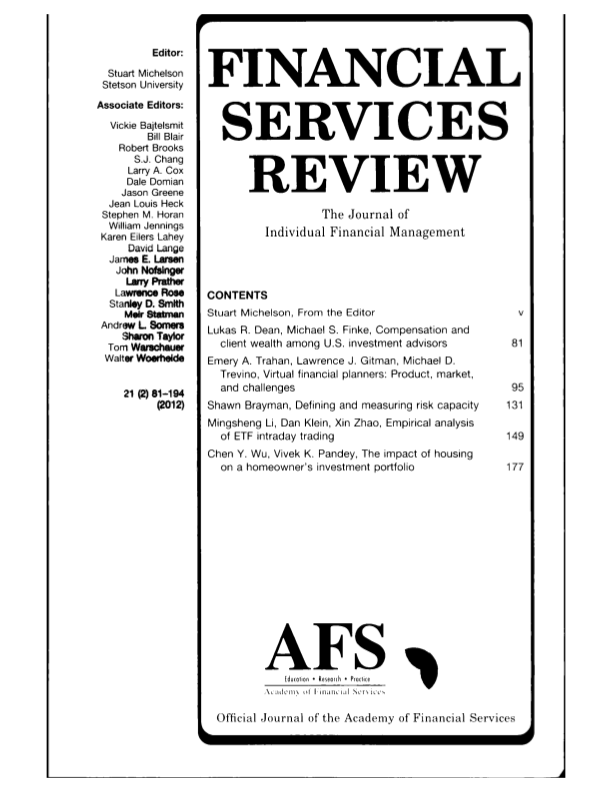
Defining and measuring risk capacity
DOI:
https://doi.org/10.61190/fsr.v21i2.4668Keywords:
Asset Allocation, Time horizon, risk capacity, risk profiling, Risk toleranceAbstract
This paper provides a definition of risk capacity and the underlying variables that contribute to it specifically the ability for the client to adjust goals; revenues from external sources like pensions; and the downside flexibility of the investment portfolio based on withdrawal strategies and portfolio construction. This paper proposes a specific metric to the measure risk capacity as opposesd to more qualitative approaches. The metric considers not only success/failure in achieving goals and terminal wealth, but looks at the frequency of shortfalls and the depth of any gaps. Using Monte Carlo simulations the proposed metric is then tested against various scenarios and illustrations using portfolios, annuities, GMWBs with adjusted returns, inflation and mortality assumptions.
Downloads
Downloads
Published
Issue
Section
License
Copyright (c) 2012 Academy of Financial Services

This work is licensed under a Creative Commons Attribution-NonCommercial 4.0 International License.
Author(s) retain the copyright and full publishing rights without restriction.
Author(s) grant the Journal right of first publication with the work simultaneously licensed under a Creative Commons Attribution-NonCommercial 4.0 International License that allows reusers to distribute, remix, adapt, and build upon the material in any medium or format, for noncommercial purposes only. Reusers must acknowledge the work's authorship and initial publication in this Journal.
Noncommercial means not primarily intended for or directed towards commercial advantage or monetary compensation.
In addition, FSR grants to the UGA Libraries a worldwide, non-exclusive license to all content published by the Journal, including metadata, that is necessary to publish, transmit, and index the Journal and to preserve its content over time.