
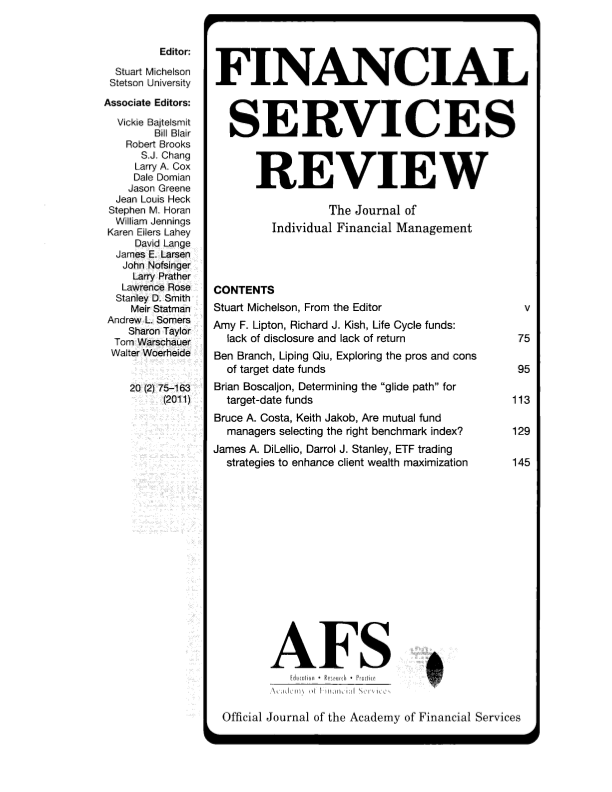
Life Cycle funds
lack of disclosure and lack of return
DOI:
https://doi.org/10.61190/fsr.v20i2.4694Keywords:
Retirement investments, Life Cycle funds, Target-date funds, Fund performance, Mutual fundsAbstract
Life Cycle funds have been a Qualified Default Investment Option for automatic enrollment for 401(k) retirement plans since 2006. Close examination of these funds and existing benchmarks reveals little transparency or uniformity in allocation, methodology, and timing. Already $340 billion, and growing, these funds' characteristics can have a significant impact on individuals' long-term investment decisions. While many studies of Life Cycle investing use simulation, our contribution is to construct simple benchmarks for empirical analysis of Life Cycle fund performance. Our analysis shows that the funds largely underperform dynamic and static benchmarks across target dates on an absolute and risk-adjusted basis.
Downloads
Downloads
Published
Issue
Section
License
Copyright (c) 2011 Academy of Financial Services

This work is licensed under a Creative Commons Attribution-NonCommercial 4.0 International License.
Author(s) retain the copyright and full publishing rights without restriction.
Author(s) grant the Journal right of first publication with the work simultaneously licensed under a Creative Commons Attribution-NonCommercial 4.0 International License that allows reusers to distribute, remix, adapt, and build upon the material in any medium or format, for noncommercial purposes only. Reusers must acknowledge the work's authorship and initial publication in this Journal.
Noncommercial means not primarily intended for or directed towards commercial advantage or monetary compensation.
In addition, FSR grants to the UGA Libraries a worldwide, non-exclusive license to all content published by the Journal, including metadata, that is necessary to publish, transmit, and index the Journal and to preserve its content over time.