
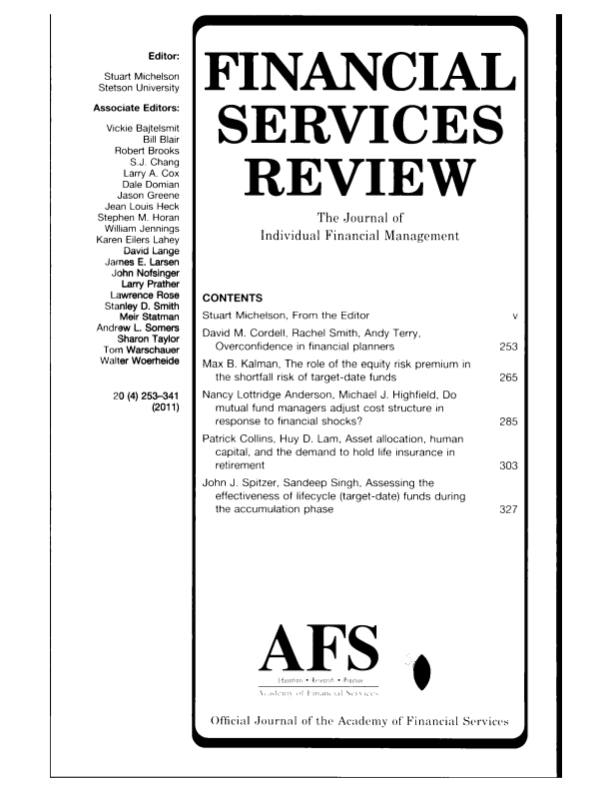
The role of the equity risk premium in the shortfall risk of target-date funds
DOI:
https://doi.org/10.61190/fsr.v20i4.4710Keywords:
Bootstrap, Retirement, Equity risk premium, Shortfall, Target-date fundAbstract
Target-date mutual funds are unique because the fund manager is expected to maintain the most efficient allocation for the investor in different investment climates. Using a bootstrap simulation with forward-looking equity risk premiums, we illustrate that a 50/50 stock/bond portfolio will run out of money less frequently than a target-date fund if future stock returns replicate past stock returns. When we introduce equity risk premium adjustments, a portfolio with a greater weight in bonds still outperforms a target-date fund. This analysis suggests that these funds may need to reconsider their asset allocation strategies irrespective of market conditions.
Downloads
Downloads
Published
Issue
Section
License
Copyright (c) 2011 Academy of Financial Services

This work is licensed under a Creative Commons Attribution-NonCommercial 4.0 International License.
Author(s) retain the copyright and full publishing rights without restriction.
Author(s) grant the Journal right of first publication with the work simultaneously licensed under a Creative Commons Attribution-NonCommercial 4.0 International License that allows reusers to distribute, remix, adapt, and build upon the material in any medium or format, for noncommercial purposes only. Reusers must acknowledge the work's authorship and initial publication in this Journal.
Noncommercial means not primarily intended for or directed towards commercial advantage or monetary compensation.
In addition, FSR grants to the UGA Libraries a worldwide, non-exclusive license to all content published by the Journal, including metadata, that is necessary to publish, transmit, and index the Journal and to preserve its content over time.