
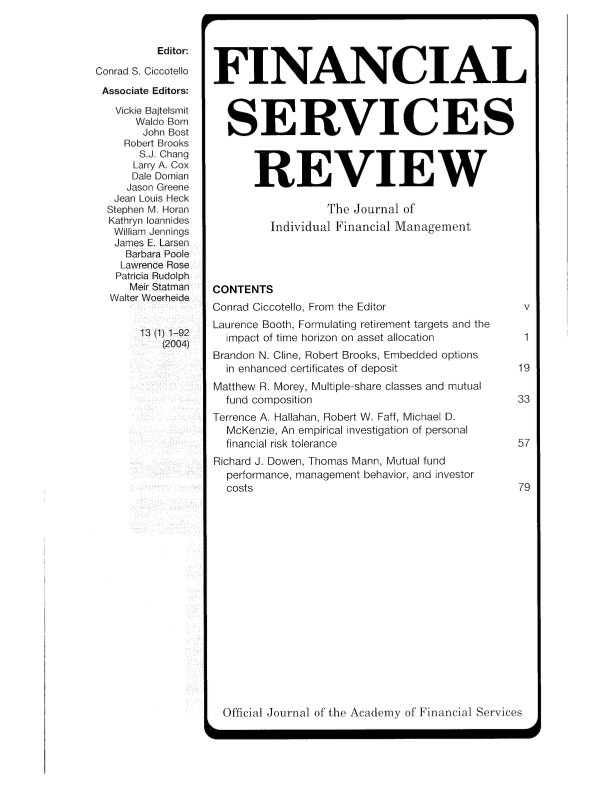
Mutual fund performance, management behavior, and investor costs
DOI:
https://doi.org/10.61190/fsr.v13i1.4783Keywords:
Potential capital gains exposure, Prospectus objective, Mutual fundsAbstract
We examine pure no-load funds over a 5-year period. For equity funds, trading activity 1s negatively related to returns. Expense ratios are not significantly related to returns. Potential capital gains exposure and tax cost ratio arc positively related to return. For fixed income funds, trading activity is positively related to return. Expense ratios and tax cost ratios are negatively related to returns. Mutual funds exhibit economies of scale and managers experience scale and scope economics. The individual investor is better off in a large fund that is a member of a large fund family.
Downloads
Downloads
Published
Issue
Section
License
Copyright (c) 2004 Academy of Financial Services

This work is licensed under a Creative Commons Attribution-NonCommercial 4.0 International License.
Author(s) retain the copyright and full publishing rights without restriction.
Author(s) grant the Journal right of first publication with the work simultaneously licensed under a Creative Commons Attribution-NonCommercial 4.0 International License that allows reusers to distribute, remix, adapt, and build upon the material in any medium or format, for noncommercial purposes only. Reusers must acknowledge the work's authorship and initial publication in this Journal.
Noncommercial means not primarily intended for or directed towards commercial advantage or monetary compensation.
In addition, FSR grants to the UGA Libraries a worldwide, non-exclusive license to all content published by the Journal, including metadata, that is necessary to publish, transmit, and index the Journal and to preserve its content over time.