
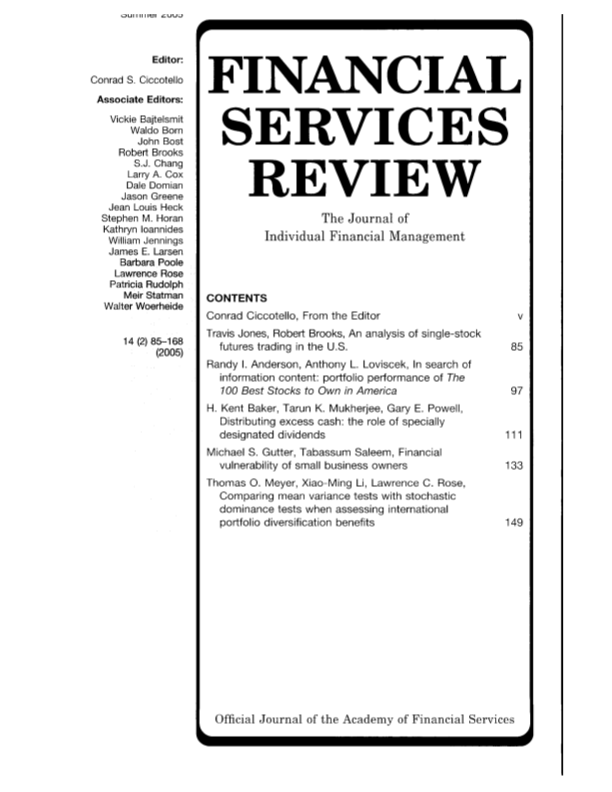
Distributing excess cash
the role of specially designated dividends
DOI:
https://doi.org/10.61190/fsr.v14i2.4820Keywords:
Share repurchases, Specially designated dividends, Payout policy, DividendsAbstract
Investors can receive cash distributions from corporations through share repurchases, regular cash dividends, and specially designated dividends (SDDs). Understanding why firms choose one method over another to distribute excess cash has important implications for investors. We find that the primary motive for repurchasing shares is to take advantage of perceived market undervaluation of the firm's shares. Having strong earnings and cash flows provide an impetus for both regular dividends increases and SDDs, but investors should view any increase in yield resulting from SDDs as temporary. They should interpret SDDs as conveying positive information about current excess performance, not long-run performance.
Downloads
Downloads
Published
Issue
Section
License
Copyright (c) 2005 Academy of Financial Services

This work is licensed under a Creative Commons Attribution-NonCommercial 4.0 International License.
Author(s) retain the copyright and full publishing rights without restriction.
Author(s) grant the Journal right of first publication with the work simultaneously licensed under a Creative Commons Attribution-NonCommercial 4.0 International License that allows reusers to distribute, remix, adapt, and build upon the material in any medium or format, for noncommercial purposes only. Reusers must acknowledge the work's authorship and initial publication in this Journal.
Noncommercial means not primarily intended for or directed towards commercial advantage or monetary compensation.
In addition, FSR grants to the UGA Libraries a worldwide, non-exclusive license to all content published by the Journal, including metadata, that is necessary to publish, transmit, and index the Journal and to preserve its content over time.