
Can individual investors duplicate professional momentum investing?
DOI:
https://doi.org/10.61190/fsr.v18i4.4956Keywords:
Individual investors, Momentum investingAbstract
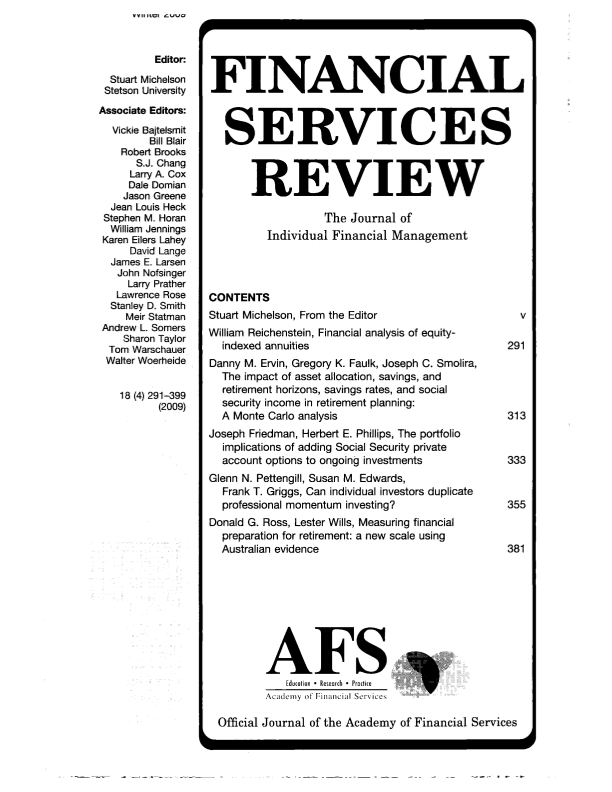
Pettengill, Edwards and Schmitt (2006) compare the selections made by the professionals and the readers in The Wall Street Journal Dartboard Contest. They find that the selections of the professionals are significantly more profitable than the selections of the readers and argue that momentum investing is not a viable choice for individual investors. In this study, we investigate whether individual investors can benefit by mimicking investment choices of professionals as displayed in this contest. In order for individual investors to benefit from this information there must be discernable differences in the selections made by the readers and the pros. We examine a number of characteristics that have been shown to cause return differentials between securities, in general, and in momentum securities, in particular. If the selections of the pros and the readers differ with respect to these characteristics and these differences can explain the observed return differentials in the contest, then individual investors might be able to mimic the momentum investing of the pros. Because we find these characteristics do not explain the return differentials between the pros and the readers, we reject the proposition that individual investors can benefit by mimicking the momentum investing behaviors of the pros.
Downloads
Downloads
Published
Issue
Section
License
Copyright (c) 2009 Academy of Financial Services

This work is licensed under a Creative Commons Attribution-NonCommercial 4.0 International License.
Author(s) retain the copyright and full publishing rights without restriction.
Author(s) grant the Journal right of first publication with the work simultaneously licensed under a Creative Commons Attribution-NonCommercial 4.0 International License that allows reusers to distribute, remix, adapt, and build upon the material in any medium or format, for noncommercial purposes only. Reusers must acknowledge the work's authorship and initial publication in this Journal.
Noncommercial means not primarily intended for or directed towards commercial advantage or monetary compensation.
In addition, FSR grants to the UGA Libraries a worldwide, non-exclusive license to all content published by the Journal, including metadata, that is necessary to publish, transmit, and index the Journal and to preserve its content over time.