
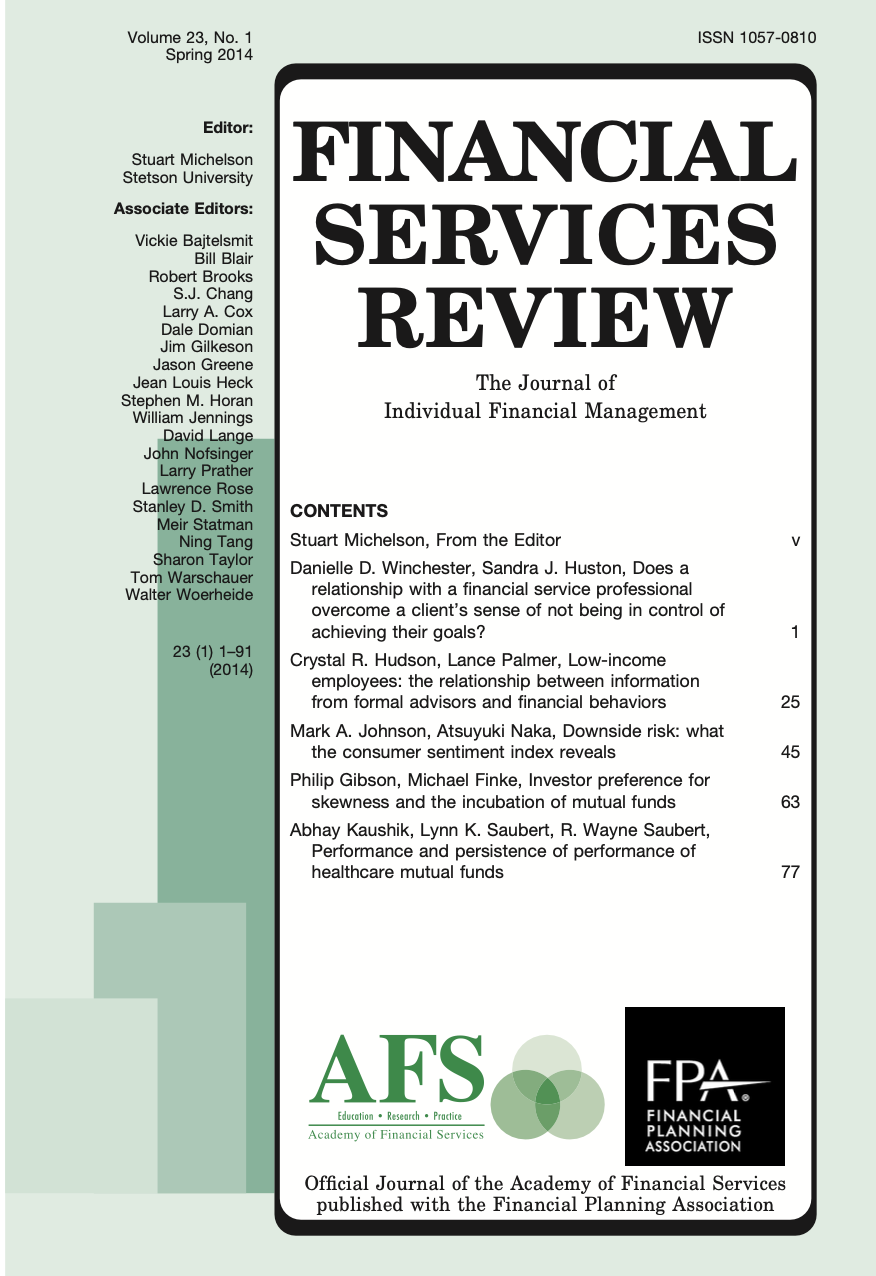
Does a relationship with a financial service professional overcome a client’s sense of not being in control of achieving their goals?
DOI:
https://doi.org/10.61190/fsr.v23i1.3183Keywords:
Financial advice, Goal progress, Self-efficacy, Behavioral controlAbstract
Although considerable evidence suggests that setting goals increases the odds of behavior changes that lead to goal attainment, less research has been conducted examining what underlying traits allow some to successfully attain their goals when others do not. This study, using the Theory of Planned Behavior, examines the affects of individual control beliefs on financial goal progress. Findings suggest that low control beliefs are significantly associated with less financial-goal progress; however, the receipt of expert financial advice can reduce this negative effect and result in higher levels of goal progress than that of individuals with high control beliefs.
Downloads
Downloads
Published
Issue
Section
License
Copyright (c) 2014 Academy of Financial Services

This work is licensed under a Creative Commons Attribution-NonCommercial 4.0 International License.
Author(s) retain the copyright and full publishing rights without restriction.
Author(s) grant the Journal right of first publication with the work simultaneously licensed under a Creative Commons Attribution-NonCommercial 4.0 International License that allows reusers to distribute, remix, adapt, and build upon the material in any medium or format, for noncommercial purposes only. Reusers must acknowledge the work's authorship and initial publication in this Journal.
Noncommercial means not primarily intended for or directed towards commercial advantage or monetary compensation.
In addition, FSR grants to the UGA Libraries a worldwide, non-exclusive license to all content published by the Journal, including metadata, that is necessary to publish, transmit, and index the Journal and to preserve its content over time.