
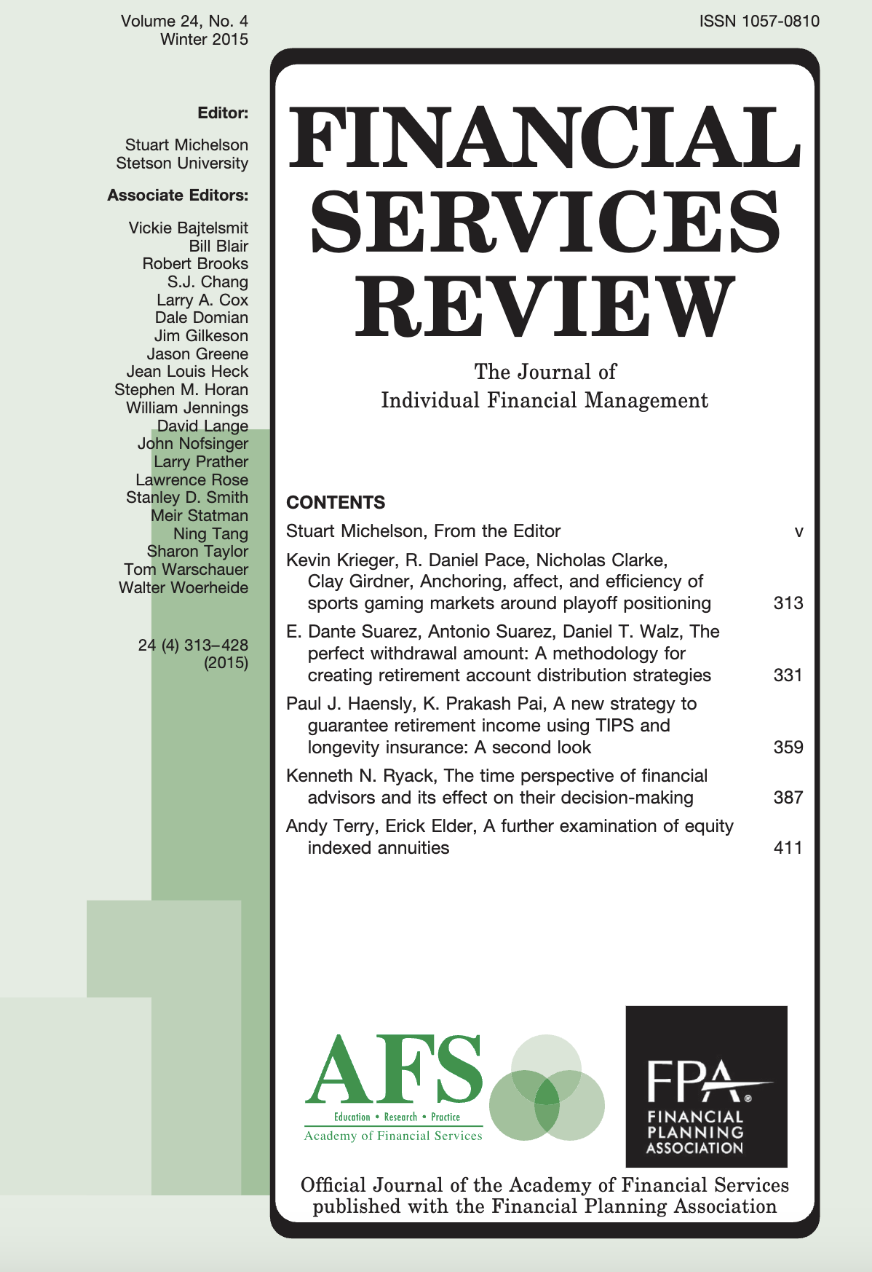
Anchoring, affect, and efficiency of sports gaming markets around playoff positioning
DOI:
https://doi.org/10.61190/fsr.v24i4.3242Keywords:
Behavioral finance, Anchoring, Affect, Market efficiency, Sports wageringAbstract
We consider the wagering market of National Football League (NFL) and National Basketball Association (NBA) games when participating teams have secured playoff positions. We use both the opening and closing lines (analogous to asset prices) of spread bets to examine if potential “letdown” effects, either psychologically or strategically, are priced. Results demonstrate that the initial opening line consistently provides a profitable strategy for those betting against teams that have clinched positions in the post-season. By the close of the betting cycle, closing lines move in the expected direction as the market partially prices the letdown. Many closing lines tighten to the extent that, after paying commissions, the naïve strategy of betting against clinched teams is less profitable. However, certain wagers, for example betting against NFL teams that have clinched top seeds, are statistically significantly economically profitable after paying commissions. These results support the behavioral finance concepts of anchoring, affect, in addition to lines moving towards efficiency.
Downloads
Downloads
Published
Issue
Section
License
Copyright (c) 2014 Academy of Financial Services

This work is licensed under a Creative Commons Attribution-NonCommercial 4.0 International License.
Author(s) retain the copyright and full publishing rights without restriction.
Author(s) grant the Journal right of first publication with the work simultaneously licensed under a Creative Commons Attribution-NonCommercial 4.0 International License that allows reusers to distribute, remix, adapt, and build upon the material in any medium or format, for noncommercial purposes only. Reusers must acknowledge the work's authorship and initial publication in this Journal.
Noncommercial means not primarily intended for or directed towards commercial advantage or monetary compensation.
In addition, FSR grants to the UGA Libraries a worldwide, non-exclusive license to all content published by the Journal, including metadata, that is necessary to publish, transmit, and index the Journal and to preserve its content over time.