
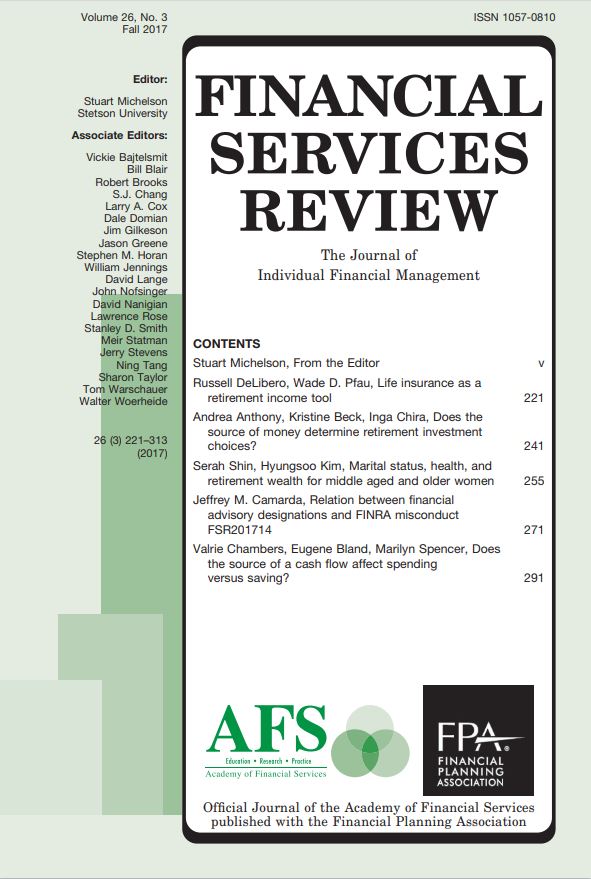
Does the source of money determine retirement investment choices?
DOI:
https://doi.org/10.61190/fsr.v26i3.3321Keywords:
403(b), Investment choices, Highly educated individuals, Investment riskAbstract
Using a unique dataset of actual investment choices of Oregon State University employees, we investigate how investment choices differ among (1) the optional retirement plan (ORP) funded by the employer and (2) the investments in 403(b) accounts funded by employees themselves using voluntary salary reduction. We find that the level of risk associated with voluntary, salary reduction investments in 403(b) accounts is lower than the risk these same employees are currently taking in their employer funded 401(a) accounts. We also investigate whether the choice of the provider has a significant impact on the asset allocation chosen by the employees and find that participant investment choices in Fidelity are riskier than the choices made by those in TIAA-CREF.
Downloads
Downloads
Published
Issue
Section
License
Copyright (c) 2014 Academy of Financial Services

This work is licensed under a Creative Commons Attribution-NonCommercial 4.0 International License.
Author(s) retain the copyright and full publishing rights without restriction.
Author(s) grant the Journal right of first publication with the work simultaneously licensed under a Creative Commons Attribution-NonCommercial 4.0 International License that allows reusers to distribute, remix, adapt, and build upon the material in any medium or format, for noncommercial purposes only. Reusers must acknowledge the work's authorship and initial publication in this Journal.
Noncommercial means not primarily intended for or directed towards commercial advantage or monetary compensation.
In addition, FSR grants to the UGA Libraries a worldwide, non-exclusive license to all content published by the Journal, including metadata, that is necessary to publish, transmit, and index the Journal and to preserve its content over time.