
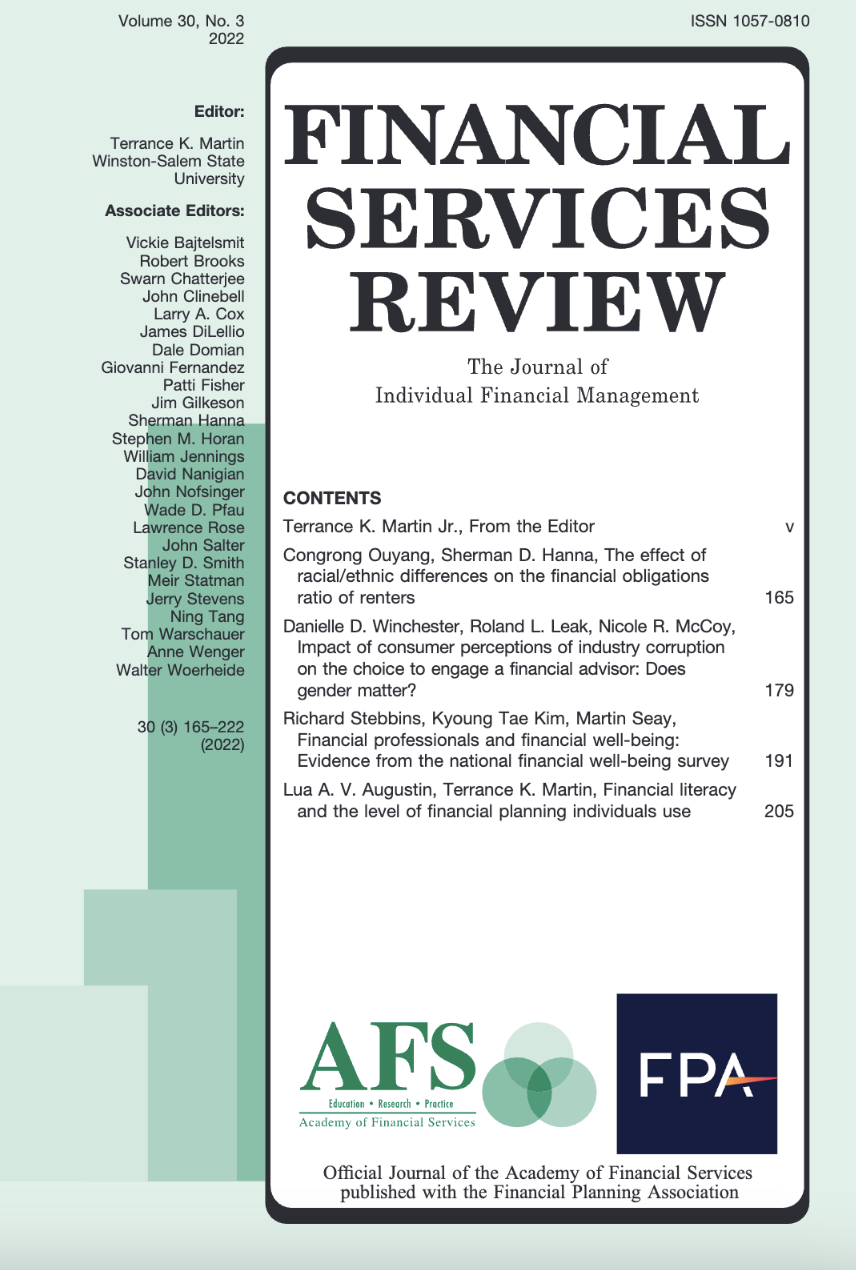
The effect of racial/ethnic differences on the financial obligations ratio of renters
DOI:
https://doi.org/10.61190/fsr.v30i3.3483Keywords:
Survey of consumer finances, Financial obligations, Financial literacyAbstract
The purpose of this research was to investigate the effects of racial/ethnic status on the ratio of finan- cial obligations payments to income among U.S. renter households. The proportion of homeowner house- holds with a ratio over 40% has decreased since 2007, but the proportion of renter households with a ratio over 40% increased until 2013 and remained high in 2016. In 2016, 13% of homeowner households and 40% of renter households had a ratio over 40%. Previous research on the financial obligations burden used an arbitrary dummy variable for whether households had a high financial obligations ratio, but we used ordinary least squares (OLS) regressions on the natural log of the ratio. For renters, based on the OLS regression, households with Black, Hispanic, and Asian respondents had higher financial obligations ratios than otherwise similar households with a White respondent. Controlling for other variables, Hispanic households had a ratio about 26% higher than White households, Asian households had a ratio 16% higher than White households, and Black households had a ratio 10% higher than White households. While discrimination could be a factor in higher ratios for the groups other than Whites, immigrant status and other factors plausibly are related.
Downloads
Downloads
Published
Issue
Section
License
Copyright (c) 2022 Academy of Financial Services

This work is licensed under a Creative Commons Attribution-NonCommercial 4.0 International License.
Author(s) retain the copyright and full publishing rights without restriction.
Author(s) grant the Journal right of first publication with the work simultaneously licensed under a Creative Commons Attribution-NonCommercial 4.0 International License that allows reusers to distribute, remix, adapt, and build upon the material in any medium or format, for noncommercial purposes only. Reusers must acknowledge the work's authorship and initial publication in this Journal.
Noncommercial means not primarily intended for or directed towards commercial advantage or monetary compensation.
In addition, FSR grants to the UGA Libraries a worldwide, non-exclusive license to all content published by the Journal, including metadata, that is necessary to publish, transmit, and index the Journal and to preserve its content over time.