
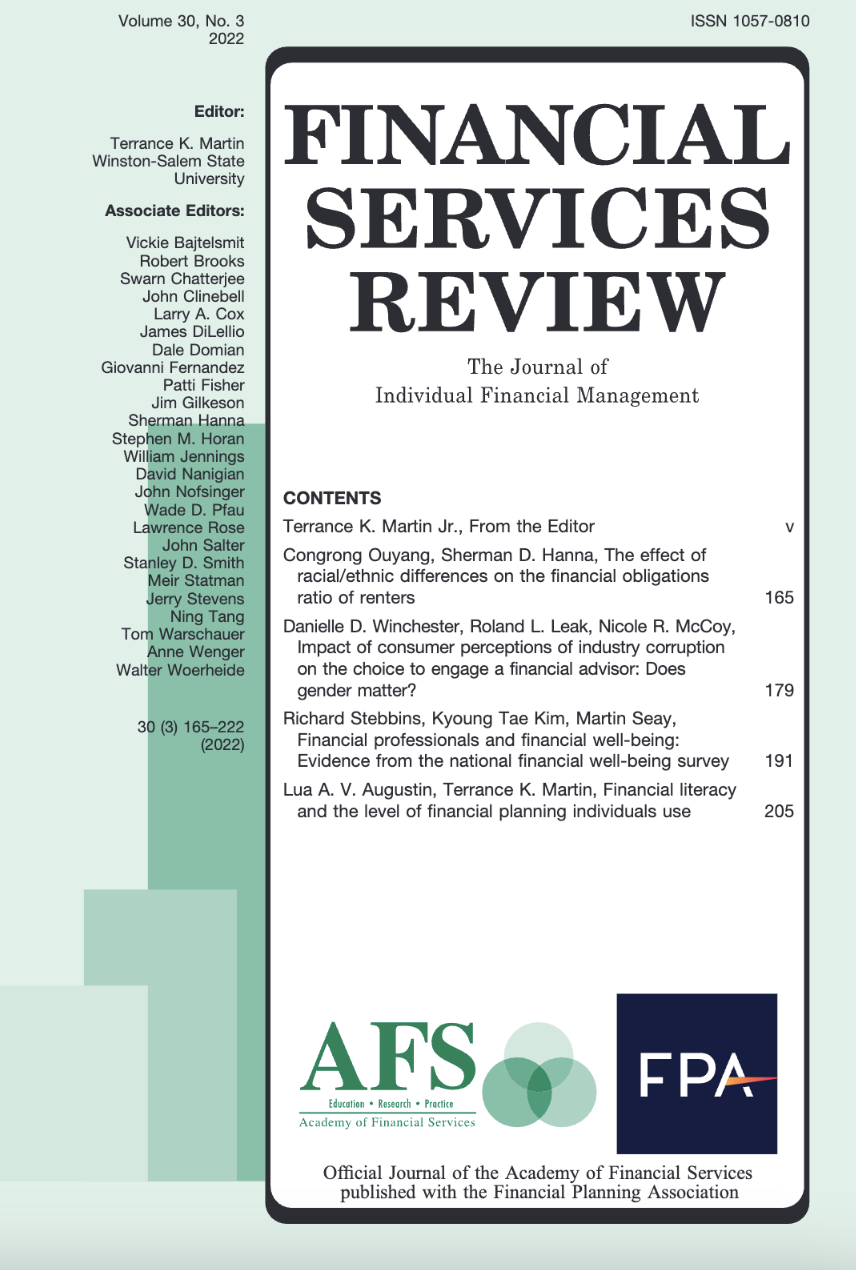
Financial literacy and the level of financial planning individuals use
DOI:
https://doi.org/10.61190/fsr.v30i3.3486Keywords:
Financial advisor, Financial planner, Financial literacyAbstract
There is little evidence in the existing literature on the relationship between financial literacy and the level of financial planning that individuals use. Different financial decisions require varying levels of financial planning, ranging from simple planning to complex planning. These decisions involve tradeoffs between taxes, retirement planning, and consumption to name a few. Making these decisions can be difficult without the right knowledge, and financial literacy can ease the decision-making pro- cess. This article evaluates the relationship between financial literacy and the level of financial planning behavior that individuals display. We use the 2012 and 2014 waves of the National Longitudinal Survey of Youth (NLSY79) and found that higher levels of financial literacy are positively associated with more “comprehensive” levels of financial planning behaviors. The results of this article indicate that individuals at the highest level of financial literacy are more likely to choose “comprehensive” planning over doing nothing at all. In addition, those with higher levels of financial literacy are also more likely to display some level of financial planning behavior compared with doing nothing at all. The implications of this may support efforts related to providing broad based financial education, with a specific focus on the value of planning, in the hopes increasing the financial literacy and level of plan- ning of the overall population.
Downloads
Downloads
Published
Issue
Section
License
Copyright (c) 2022 Academy of Financial Services

This work is licensed under a Creative Commons Attribution-NonCommercial 4.0 International License.
Author(s) retain the copyright and full publishing rights without restriction.
Author(s) grant the Journal right of first publication with the work simultaneously licensed under a Creative Commons Attribution-NonCommercial 4.0 International License that allows reusers to distribute, remix, adapt, and build upon the material in any medium or format, for noncommercial purposes only. Reusers must acknowledge the work's authorship and initial publication in this Journal.
Noncommercial means not primarily intended for or directed towards commercial advantage or monetary compensation.
In addition, FSR grants to the UGA Libraries a worldwide, non-exclusive license to all content published by the Journal, including metadata, that is necessary to publish, transmit, and index the Journal and to preserve its content over time.