
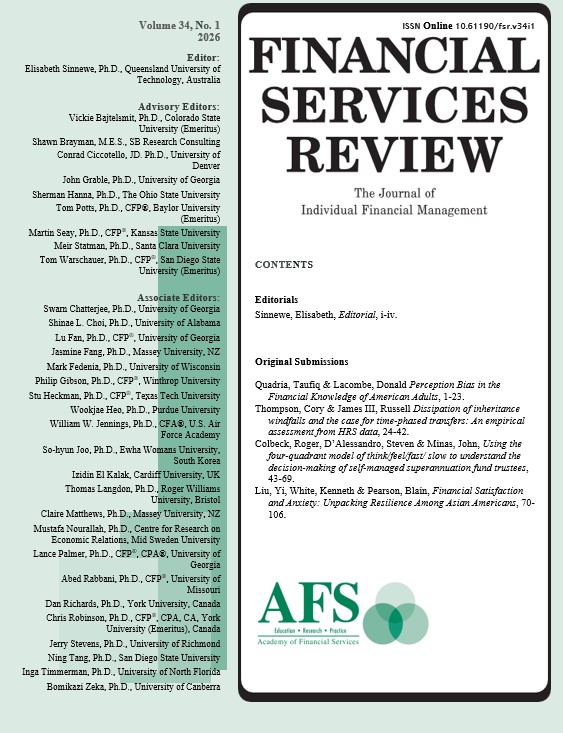
Perception Bias in the Financial Knowledge of American Adults
DOI:
https://doi.org/10.61190/fsr.v34i1.3629Keywords:
perception-bias, financial-knowledgeAbstract
Perception biases—individuals’ tendency to either overestimate or underestimate their abilities—exist in the domain of financial knowledge. This study utilizes data from a nationally representative sample of 26,218 American adults provided by the 2018 National Financial Capability Study. A two-step procedure is used to analyze the data. In the first step, ordered-probit regression models are used to estimate subjective financial knowledge as a function of objective financial knowledge. The surrogate residuals from these models represent the degree to which subjective knowledge deviates from objective knowledge and are interpreted as measures of perception bias. In the second step, variable-intercept mixed-effects models are estimated to identify the predictors of perception bias in financial knowledge. The results show that individuals with higher perceived math ability and higher risk-taking attitudes are more likely to overestimate their financial knowledge. Surprisingly, individuals who participated in financial education programs or lived in states requiring financial education were also more likely to overestimate their knowledge. These findings have important implications for financial educators, advisors, and policymakers.
Downloads
Downloads
Published
Issue
Section
License
Copyright (c) 2026 Taufiq Quadria, Donald Lacombe

This work is licensed under a Creative Commons Attribution-NonCommercial 4.0 International License.
Author(s) retain the copyright and full publishing rights without restriction.
Author(s) grant the Journal right of first publication with the work simultaneously licensed under a Creative Commons Attribution-NonCommercial 4.0 International License that allows reusers to distribute, remix, adapt, and build upon the material in any medium or format, for noncommercial purposes only. Reusers must acknowledge the work's authorship and initial publication in this Journal.
Noncommercial means not primarily intended for or directed towards commercial advantage or monetary compensation.
In addition, FSR grants to the UGA Libraries a worldwide, non-exclusive license to all content published by the Journal, including metadata, that is necessary to publish, transmit, and index the Journal and to preserve its content over time.