
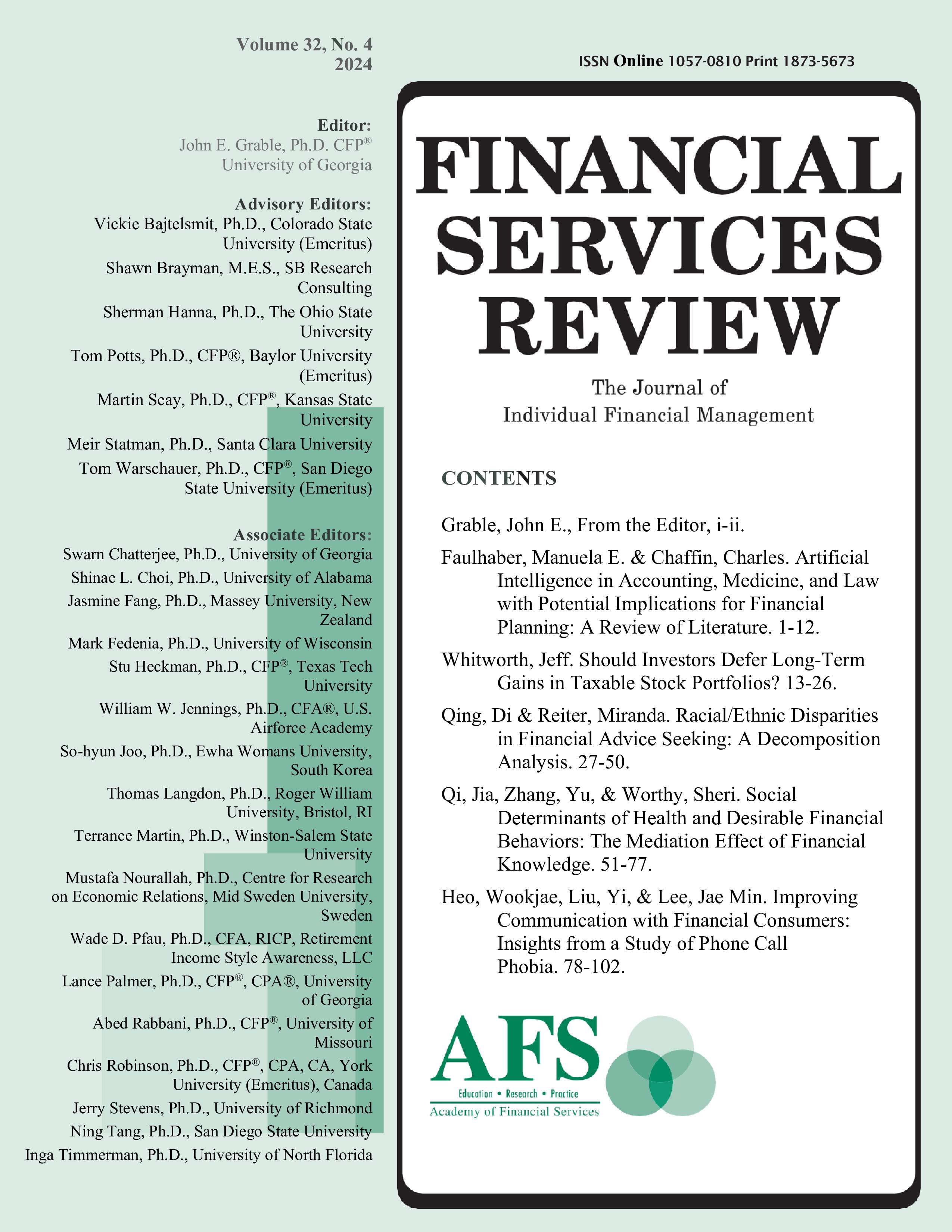
Should Investors Defer Long-Term Gains in Taxable Stock Portfolios?
DOI:
https://doi.org/10.61190/fsr.v32i4.3996Keywords:
Diversification return, Capital gains taxes, Investment riskAbstract
Investors with taxable portfolios sometimes delay the sale of appreciated stock to defer capital gains taxes. While this strategy does help to reduce taxes, it can cause the portfolio to become more concentrated over time, leading to higher overall volatility and lower long-term returns. This paper evaluates the tradeoff between tax efficiency and diversification via Monte Carlo simulation and finds that diversification is far more important for the investor’s terminal wealth, especially over longer time horizons. Under a reasonable set of assumptions, investors are better off rebalancing almost completely each year, even though it requires selling some recent winners and paying capital gains taxes. While tax efficiency does become somewhat more important for individuals who are taxed more heavily on gains or who expect an eventual step-up in basis, even these investors should tolerate only a modest increase in portfolio concentration.
Downloads
Downloads
Published
Issue
Section
License
Copyright (c) 2024 Jeff Whitworth

This work is licensed under a Creative Commons Attribution-NonCommercial 4.0 International License.
Author(s) retain the copyright and full publishing rights without restriction.
Author(s) grant the Journal right of first publication with the work simultaneously licensed under a Creative Commons Attribution-NonCommercial 4.0 International License that allows reusers to distribute, remix, adapt, and build upon the material in any medium or format, for noncommercial purposes only. Reusers must acknowledge the work's authorship and initial publication in this Journal.
Noncommercial means not primarily intended for or directed towards commercial advantage or monetary compensation.
In addition, FSR grants to the UGA Libraries a worldwide, non-exclusive license to all content published by the Journal, including metadata, that is necessary to publish, transmit, and index the Journal and to preserve its content over time.