
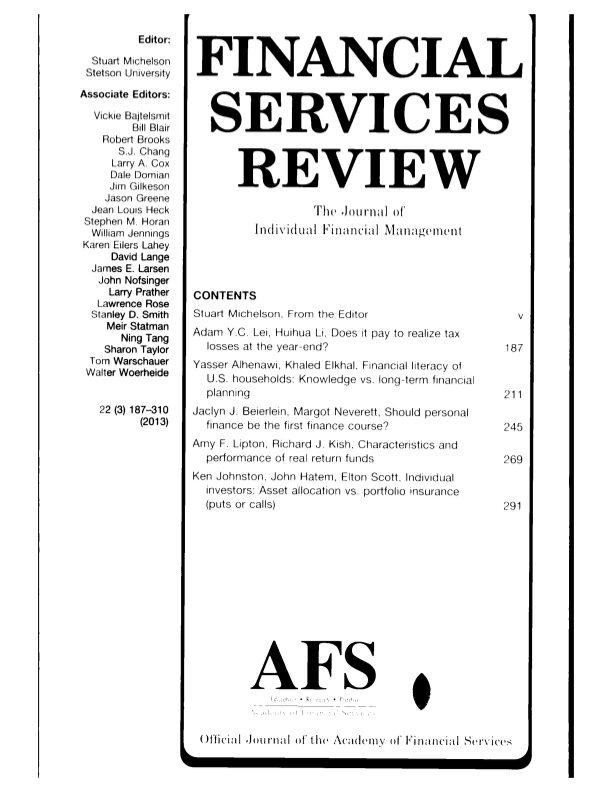
Does it pay to realize tax losses at the year-end?
DOI:
https://doi.org/10.61190/fsr.v22i3.4652Keywords:
Simulation, Tax-loss selling, Investment strategyAbstract
Motivated by the widely touted practice, we examine the effects of realizing tax losses at the year-end on simulated stock portfolios. Our results indicate that the timing of portfolio formation, the cutoff that triggers the loss realization, the length of an investor's holding period, and to a lesser extent, the timing of the tax benefits, all affect the probability that the tax-loss strategy outperforms a simple buy-and-hold strategy. Collectively, our findings support the tax-loss strategy in general, but they also suggest that factors other than an investor's applicable tax rate affect the effectiveness of this strategy as well.
Downloads
Downloads
Published
Issue
Section
License
Copyright (c) 2013 Academy of Financial Services

This work is licensed under a Creative Commons Attribution-NonCommercial 4.0 International License.
Author(s) retain the copyright and full publishing rights without restriction.
Author(s) grant the Journal right of first publication with the work simultaneously licensed under a Creative Commons Attribution-NonCommercial 4.0 International License that allows reusers to distribute, remix, adapt, and build upon the material in any medium or format, for noncommercial purposes only. Reusers must acknowledge the work's authorship and initial publication in this Journal.
Noncommercial means not primarily intended for or directed towards commercial advantage or monetary compensation.
In addition, FSR grants to the UGA Libraries a worldwide, non-exclusive license to all content published by the Journal, including metadata, that is necessary to publish, transmit, and index the Journal and to preserve its content over time.