
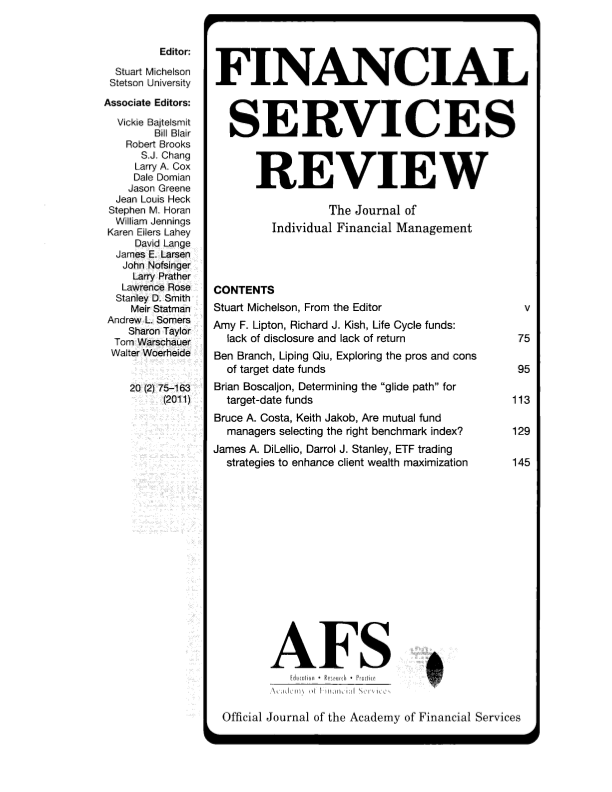
Are mutual fund managers selecting the right benchmark index?
DOI:
https://doi.org/10.61190/fsr.v20i2.4697Keywords:
Benchmark index, Mutual funds, PerformanceAbstract
In this paper, we determine index suitability for mutual funds that specify the S&P 500 as their performance benchmark. Using a four-factor model, we calculate factor loadings for mutual funds and their benchmark index and measure deviations with respect to the risk factors in the model. We sort the funds into growth and value subsets. By comparing each fund with the appropriate growth or value index, we show that the inferences regarding abnormal fund performance change dramatically. Our results indicate that fine tuning of abnormal performance measurement can significantly alter infer ences regarding the fund manager's contribution to mutual fund performance. Using this methodol ogy, investors and academics can more accurately assess mutual fund manager performance relative to an appropriate benchmark, regardless of the target index selected by the management of the mutual fund.
Downloads
Downloads
Published
Issue
Section
License
Copyright (c) 2011 Academy of Financial Services

This work is licensed under a Creative Commons Attribution-NonCommercial 4.0 International License.
Author(s) retain the copyright and full publishing rights without restriction.
Author(s) grant the Journal right of first publication with the work simultaneously licensed under a Creative Commons Attribution-NonCommercial 4.0 International License that allows reusers to distribute, remix, adapt, and build upon the material in any medium or format, for noncommercial purposes only. Reusers must acknowledge the work's authorship and initial publication in this Journal.
Noncommercial means not primarily intended for or directed towards commercial advantage or monetary compensation.
In addition, FSR grants to the UGA Libraries a worldwide, non-exclusive license to all content published by the Journal, including metadata, that is necessary to publish, transmit, and index the Journal and to preserve its content over time.