
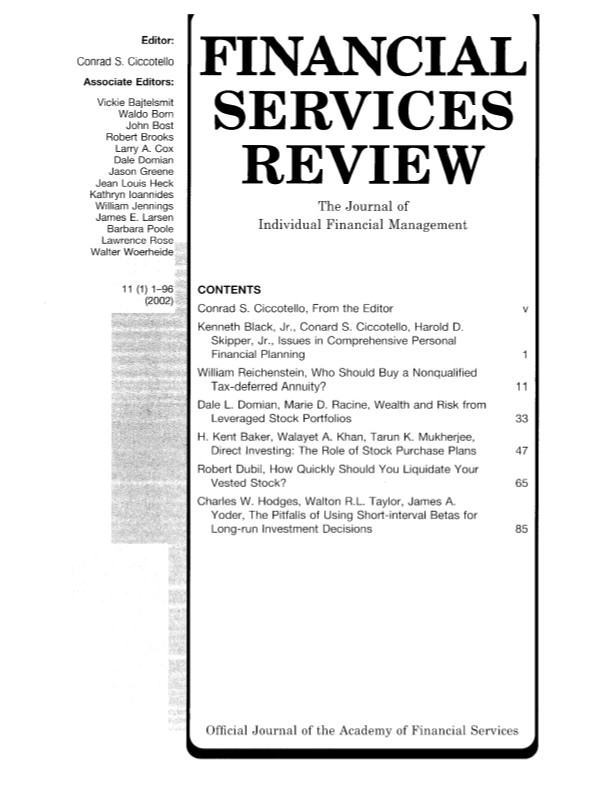
The Pitfalls of Using Short-interval Betas for Long-run Investment Decisions
DOI:
https://doi.org/10.61190/fsr.v11i1.4723Keywords:
Treynor ratio, Investment horizon, BetaAbstract
We investigate empirical relationships between beta, the Treynor ratio, and the investment horizon for portfolios of small stocks, large stocks, and bonds. Betas and Treynor ratios are computed for holding periods of to 30 years. For both the stock and bond portfolios, beta and the Treynor ratio change substantially with the holding period. Furthermore, the relative Treynor rankings of the portfolios change. Therefore, betas and Treynor ratios cannot be calculated independently of the intended investment horizon. Our results suggest that the impact of one's assumed investment horizon has not received sufficient attention in computing systematic risk (beta) or interpreting reward-to-risk performance measures (such as the Treynor ratio, Sharpe ratio, or Jensen's alpha). Thus, investors with long-run investment horizons must interpret performance parameters obtained from investment advisory services with due consideration for horizon effects.
Downloads
Downloads
Published
Issue
Section
License
Copyright (c) 2002 Academy of Financial Services

This work is licensed under a Creative Commons Attribution-NonCommercial 4.0 International License.
Author(s) retain the copyright and full publishing rights without restriction.
Author(s) grant the Journal right of first publication with the work simultaneously licensed under a Creative Commons Attribution-NonCommercial 4.0 International License that allows reusers to distribute, remix, adapt, and build upon the material in any medium or format, for noncommercial purposes only. Reusers must acknowledge the work's authorship and initial publication in this Journal.
Noncommercial means not primarily intended for or directed towards commercial advantage or monetary compensation.
In addition, FSR grants to the UGA Libraries a worldwide, non-exclusive license to all content published by the Journal, including metadata, that is necessary to publish, transmit, and index the Journal and to preserve its content over time.