
Equity Allocations and the Investment Horizon
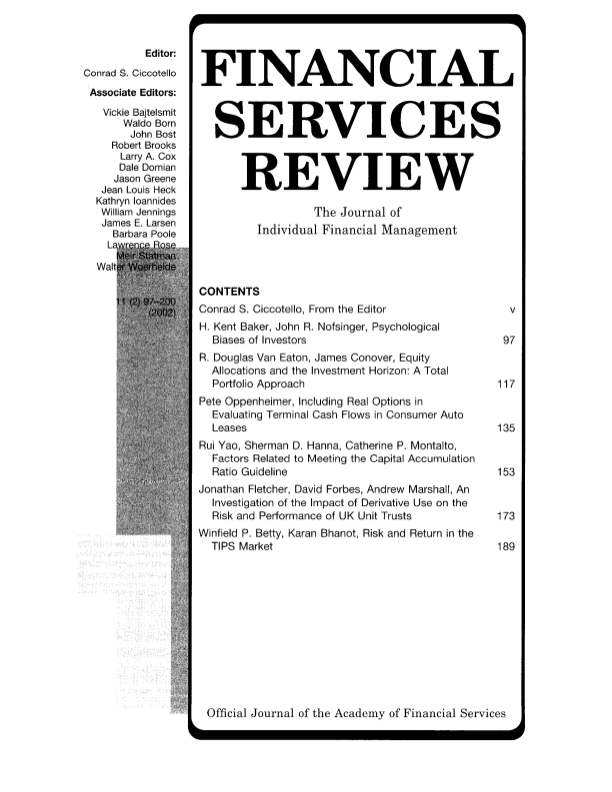
A Total Portfolio Approach
DOI:
https://doi.org/10.61190/fsr.v11i2.4727Keywords:
Life-cycle hypothesis, Retirement accounts, Long time horizon, Asset allocation, Total wealth portfolioAbstract
We offer a streamlined life-cycle model that provides support for the common advice given to investors to hold large initial equity allocations among financial assets and then reduce them as retirement nears. We examine how total portfolio wealth varies at different horizons. We find that if the financial component of a total retirement portfolio is large (small), compared to anticipated future contributions, then the equity allocation should be reduced (increased) to target that individual's desired risky asset allocation of total wealth. Our examples and historical tests favor allocation strategies that depend on individual financial circumstances and portfolio horizons. But, somewhat surprisingly, even highly risk-averse individuals should choose to hold all equity retirement portfolios when beginning to save for retirement.
Downloads
Downloads
Published
Issue
Section
License
Copyright (c) 2002 Academy of Financial Services

This work is licensed under a Creative Commons Attribution-NonCommercial 4.0 International License.
Author(s) retain the copyright and full publishing rights without restriction.
Author(s) grant the Journal right of first publication with the work simultaneously licensed under a Creative Commons Attribution-NonCommercial 4.0 International License that allows reusers to distribute, remix, adapt, and build upon the material in any medium or format, for noncommercial purposes only. Reusers must acknowledge the work's authorship and initial publication in this Journal.
Noncommercial means not primarily intended for or directed towards commercial advantage or monetary compensation.
In addition, FSR grants to the UGA Libraries a worldwide, non-exclusive license to all content published by the Journal, including metadata, that is necessary to publish, transmit, and index the Journal and to preserve its content over time.