
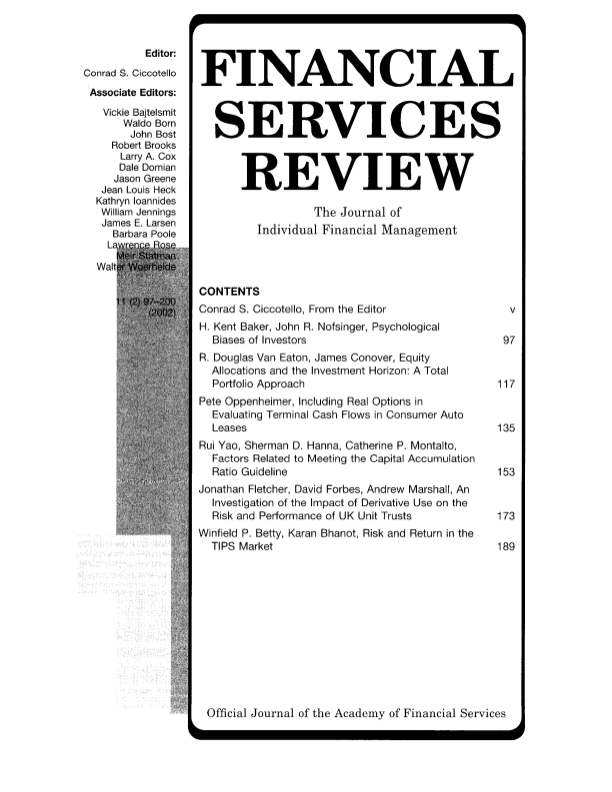
An Investigation of the Impact of Derivative Use on the Risk and Performance of UK Unit Trusts
DOI:
https://doi.org/10.61190/fsr.v11i2.4730Keywords:
Risk, Performance, Unit trusts, DerivativesAbstract
A popular investment choice for UK investors is unit trusts. This paper examines the impact of derivative use on the risk, performance, and risk management of UK unit trusts between January 1995 and December 1997, extending an earlier US study. Despite the well-documented increased use of derivatives by corporate investors, approximately three-quarters of our UK sample did not use derivatives, consistent with US evidence. The main findings of the paper show that the cross-sectional variability of a number of risk measures tends to be larger for trusts that use derivatives compared with those who do not use derivatives. Derivative use tends to have little influence on performance inferences for the overall sample of trusts but does for some investment sectors of our trust sample. Finally, and in contrast to evidence in the US, trusts that use derivatives tend to have less severe changes in risk due to past performance within a calendar year. The findings have important implications for the existing regulations in the UK on derivative use by unit trusts that prohibit the use of derivatives for speculative purposes and for the large number of individual investors who invest in these trusts.
Downloads
Downloads
Published
Issue
Section
License
Copyright (c) 2002 Academy of Financial Services

This work is licensed under a Creative Commons Attribution-NonCommercial 4.0 International License.
Author(s) retain the copyright and full publishing rights without restriction.
Author(s) grant the Journal right of first publication with the work simultaneously licensed under a Creative Commons Attribution-NonCommercial 4.0 International License that allows reusers to distribute, remix, adapt, and build upon the material in any medium or format, for noncommercial purposes only. Reusers must acknowledge the work's authorship and initial publication in this Journal.
Noncommercial means not primarily intended for or directed towards commercial advantage or monetary compensation.
In addition, FSR grants to the UGA Libraries a worldwide, non-exclusive license to all content published by the Journal, including metadata, that is necessary to publish, transmit, and index the Journal and to preserve its content over time.