
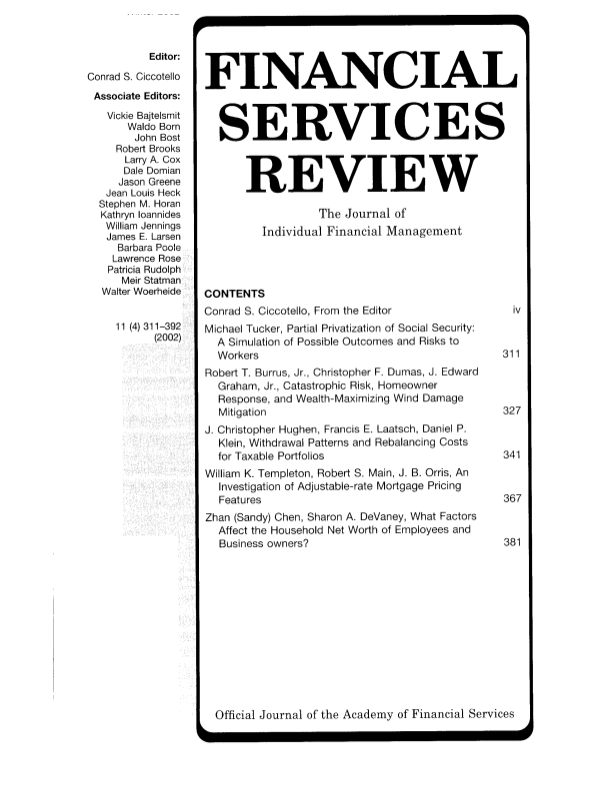
Withdrawal Patterns and Rebalancing Costs for Taxable Portfolios
DOI:
https://doi.org/10.61190/fsr.v11i4.4745Keywords:
Taxes, Asset allocation, Retirement planningAbstract
This article quantifies the effect of taxes on the magnitude and variability of cash flows from taxable retirement portfolios. While previous research focuses on pretax cash flows, this paper includes taxes associated with rebalancing and withdrawals. We incorporate the differential tax treatment of interest income and capital gains. Taxes have dramatic effects on the size and variability of the after-tax cash flows withdrawn from the portfolio. Financial planners may use our results to determine the ideal equity allocation in taxable retirement portfolios. For withdrawals below 5% and above 8% of initial portfolio value, our results suggest that the 100% equity allocation generally provides the most attractive trade-off between risk and return during the retirement period. Even for withdrawals (as a percentage of initial portfolio value) from 5% to 8%, the 100% equity allocation is an attractive choice because it has substantially higher mean terminal value and similarly higher mean after-tax cash flows. An analysis of inflation-adjusted withdrawal amounts also strongly favors the 1009c equity allocation.
Downloads
Downloads
Published
Issue
Section
License
Copyright (c) 2002 Academy of Financial Services

This work is licensed under a Creative Commons Attribution-NonCommercial 4.0 International License.
Author(s) retain the copyright and full publishing rights without restriction.
Author(s) grant the Journal right of first publication with the work simultaneously licensed under a Creative Commons Attribution-NonCommercial 4.0 International License that allows reusers to distribute, remix, adapt, and build upon the material in any medium or format, for noncommercial purposes only. Reusers must acknowledge the work's authorship and initial publication in this Journal.
Noncommercial means not primarily intended for or directed towards commercial advantage or monetary compensation.
In addition, FSR grants to the UGA Libraries a worldwide, non-exclusive license to all content published by the Journal, including metadata, that is necessary to publish, transmit, and index the Journal and to preserve its content over time.