
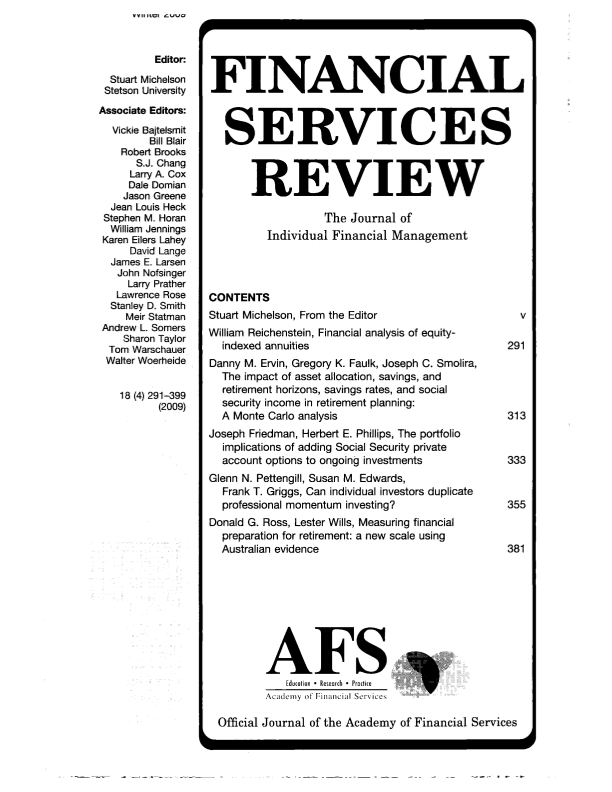
The impact of asset allocation, savings, and retirement horizons, savings rates, and social security income in retirement planning
A Monte Carlo analysis
DOI:
https://doi.org/10.61190/fsr.v18i4.4954Keywords:
Portfolio choice, Retirement planningAbstract
This study uses Monte Carlo simulation to evaluate the ability of various deposit percentages and asset allocation weights to support withdrawals in retirement that permit smoothed income over the life of an individual. The results indicate that, in general, individuals need to deposit at least 15% of pre-retirement salary for 30 or more years in a portfolio consisting of at least 50% equity to achieve a high success rate for portfolio withdrawals. When Social Security payments are excluded from the retirement income, the success rate is greatly impacted by the savings rate, the savings period, and the amount of equity investment in the portfolio.
Downloads
Downloads
Published
Issue
Section
License
Copyright (c) 2009 Academy of Financial Services

This work is licensed under a Creative Commons Attribution-NonCommercial 4.0 International License.
Author(s) retain the copyright and full publishing rights without restriction.
Author(s) grant the Journal right of first publication with the work simultaneously licensed under a Creative Commons Attribution-NonCommercial 4.0 International License that allows reusers to distribute, remix, adapt, and build upon the material in any medium or format, for noncommercial purposes only. Reusers must acknowledge the work's authorship and initial publication in this Journal.
Noncommercial means not primarily intended for or directed towards commercial advantage or monetary compensation.
In addition, FSR grants to the UGA Libraries a worldwide, non-exclusive license to all content published by the Journal, including metadata, that is necessary to publish, transmit, and index the Journal and to preserve its content over time.