
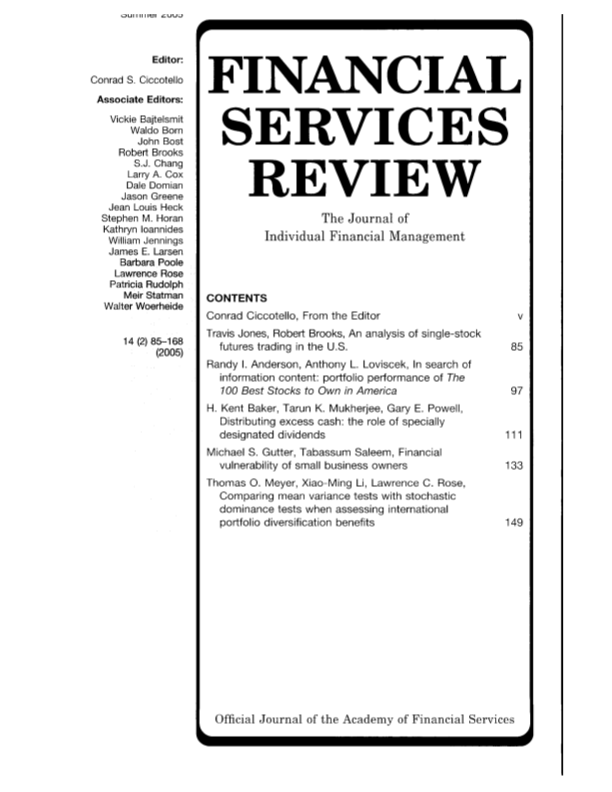
Comparing mean variance tests with stochastic dominance tests when assessing international portfolio diversification benefits
DOI:
https://doi.org/10.61190/fsr.v14i2.4822Keywords:
Portfolio optimization, Asian crisis, International diversification, Stochastic dominanceAbstract
Stochastic dominance is theoretically superior to mean-variance (MY) analysis because it considers the entire return distribution and is based on minimally restrictive assumptions regarding investor motives. This study uses stochastic dominance to examine whether adding internationally based assets to a wholly domestic portfolio generates diversification benefits for an investor. In contrast to previous MY findings, a New Zealand-only portfolio stochastically dominates four internationally diversified portfolios across all periods considered. Similarly, the least internationally diversified portfolio persistently dominates more diversified counterparts. Within-portfolio analysis shows that in the Asian Crisis period, the least risky or lowest return weighting schemes dominate those with greater risk and/or higher return characteristics.
Downloads
Downloads
Published
Issue
Section
License
Copyright (c) 2005 Academy of Financial Services

This work is licensed under a Creative Commons Attribution-NonCommercial 4.0 International License.
Author(s) retain the copyright and full publishing rights without restriction.
Author(s) grant the Journal right of first publication with the work simultaneously licensed under a Creative Commons Attribution-NonCommercial 4.0 International License that allows reusers to distribute, remix, adapt, and build upon the material in any medium or format, for noncommercial purposes only. Reusers must acknowledge the work's authorship and initial publication in this Journal.
Noncommercial means not primarily intended for or directed towards commercial advantage or monetary compensation.
In addition, FSR grants to the UGA Libraries a worldwide, non-exclusive license to all content published by the Journal, including metadata, that is necessary to publish, transmit, and index the Journal and to preserve its content over time.