
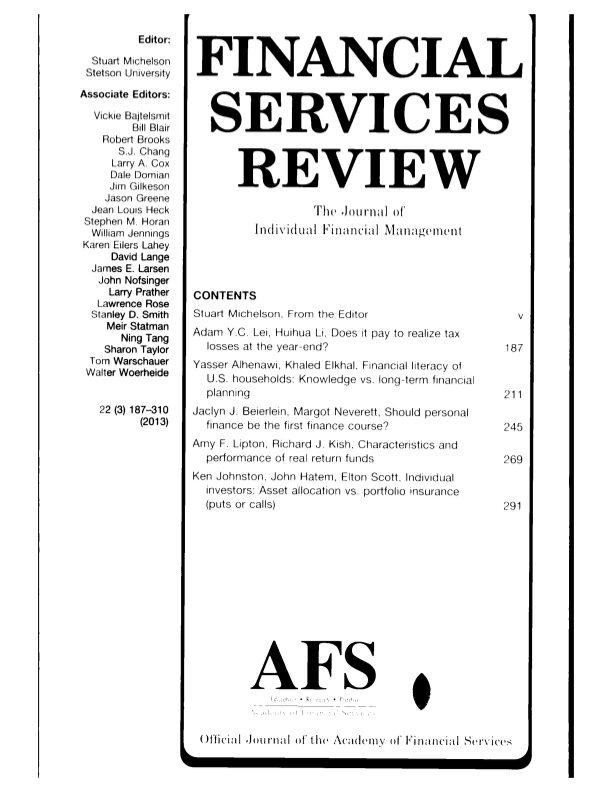
Individual investors
Asset allocation vs. portfolio insurance (puts or calls)
DOI:
https://doi.org/10.61190/fsr.v22i3.4657Keywords:
Options, Portfolio insurance, Asset allocationAbstract
The purpose of this study is to test if an individual can successfully use index options to partially replace fixed income securities in an individual's retirement portfolio. Two types of option insurance portfolios are examined. Put option insurance portfolios are created by selling fixed percentages of a stock index portfolio and using the proceeds to purchase index put options. Call option insurance portfolios are created by writing index options worth fixed percentages of a stock index portfolio and using the proceeds to purchase more of the stock index (covered call option insurance is also examined). The use of put options in the portfolio should allow the investor to reduce downside risk, as they age, similar to increasing the bond allocation, while also allowing the investor to participate in increased upside potential by having a higher percentage of the portfolio invested in stocks. Along with increased potential for returns with a larger percentage of the portfolio invested in stocks, the income the investor receives by writing call options and investing them in more of the stock index may also provide the investor some protection against losses in exchange for limiting potential gains. Results indicate that shifting asset allocation appears to be the better strategy when compared with the put option insurance portfolios. Overall the call option insurance portfolios returns are superior to the asset allocation portfolios. On a risk adjusted basis, an argument can be made that the fixed percentage call option insurance portfolios outperform the asset allocation portfolios, when the asset allocation favors stocks.
Downloads
Downloads
Published
Issue
Section
License
Copyright (c) 2013 Academy of Financial Services

This work is licensed under a Creative Commons Attribution-NonCommercial 4.0 International License.
Author(s) retain the copyright and full publishing rights without restriction.
Author(s) grant the Journal right of first publication with the work simultaneously licensed under a Creative Commons Attribution-NonCommercial 4.0 International License that allows reusers to distribute, remix, adapt, and build upon the material in any medium or format, for noncommercial purposes only. Reusers must acknowledge the work's authorship and initial publication in this Journal.
Noncommercial means not primarily intended for or directed towards commercial advantage or monetary compensation.
In addition, FSR grants to the UGA Libraries a worldwide, non-exclusive license to all content published by the Journal, including metadata, that is necessary to publish, transmit, and index the Journal and to preserve its content over time.