
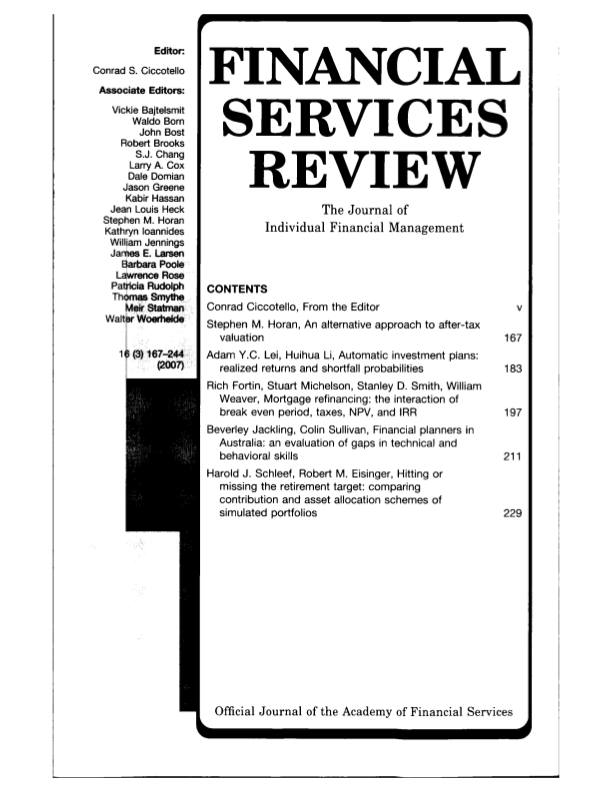
Hitting or missing the retirement target
comparing contribution and asset allocation schemes of simulated portfolios
DOI:
https://doi.org/10.61190/fsr.v16i3.4892Keywords:
Portfolio risk, Retirement planningAbstract
Personal financial planning entails establishing retirement portfolio goals, which may be identified as specific portfolio target values. The problem of investing to build a retirement portfolio that achieves a specified value at retirement can be modeled as a dynamic multiperiod portfolio problem. Although theoretically robust, the dynamic programming approach to multiperiod portfolio analysis is computationally intractable. In contrast, this paper uses Monte Carlo simulation to analyze specific asset allocations in the context of multiperiod planning. We consider achieving a target portfolio value at a specific point in time. We conclude that 'life-cycle funds' that reduce equity allocations over time fail to increase the likelihood of reaching a targeted portfolio value compared with fixed asset allocation models (e.g., 80% equity/20% bond).
Downloads
Downloads
Published
Issue
Section
License
Copyright (c) 2007 Academy of Financial Services

This work is licensed under a Creative Commons Attribution-NonCommercial 4.0 International License.
Author(s) retain the copyright and full publishing rights without restriction.
Author(s) grant the Journal right of first publication with the work simultaneously licensed under a Creative Commons Attribution-NonCommercial 4.0 International License that allows reusers to distribute, remix, adapt, and build upon the material in any medium or format, for noncommercial purposes only. Reusers must acknowledge the work's authorship and initial publication in this Journal.
Noncommercial means not primarily intended for or directed towards commercial advantage or monetary compensation.
In addition, FSR grants to the UGA Libraries a worldwide, non-exclusive license to all content published by the Journal, including metadata, that is necessary to publish, transmit, and index the Journal and to preserve its content over time.