Information For Authors
Interested in submitting to PHFL? We recommend that you review the About the Journal page for the journal's section policies, as well as the Author Guidelines. Authors need to register with the journal prior to submitting or, if already registered, can simply log in and begin the submission process.
Publication Ethics and Responsibilities
Author Expectations
Authors listed on a submission to PHFL must meet all of the following criteria:
(a) Made a substantial contribution to the conception and design of the study, data analysis, or interpretation;
(b) Drafted or critically revised the manuscript for important intellectual content;
(c) Approved the final version of the manuscript; and
(d) Conducted the work with integrity and honesty.
The corresponding author must be familiar with the underlying data (if applicable) and assumes responsibility for the integrity and accuracy of the manuscript. If any portion of a published paper is later found to be faulty, misleading, or fraudulent, all co-authors may share responsibility.
Conflicts of Interest
At the time of submission, authors must disclose any real, perceived, or potential conflicts of interest—financial or otherwise—including but not limited to consulting relationships, business ownership, equity interests, patent-licensing arrangements, funding constraints affecting publication decisions, or related professional engagements.
Authors of invited manuscripts must also disclose conflicts related to relevant work conducted within the past three years.
Failure to disclose conflicts prior to peer review may result in review delays, manuscript rejection, or post-publication action.
Data Access and Retention
Authors may be asked to provide raw data, instruments, coding syntax, or related materials for editorial review. Authors should be prepared to make data publicly available when practicable.
At minimum, authors are expected to maintain access to underlying data for at least ten (10) years following publication. Data should be stored in an institutional repository, subject-based archive, or secure data center whenever possible, provided participant confidentiality is protected and legal or proprietary restrictions do not prohibit release.
Plagiarism, Fabrication, and Falsification
Manuscripts submitted to PHFL must not contain plagiarized, fabricated, or falsified material.
- Plagiarism includes presenting another person’s ideas, words, or materials without proper attribution.
- Fabrication involves making up data or results.
- Falsification involves manipulating research materials, equipment, processes, or data to misrepresent findings.
Violations may result in rejection, retraction, and/or notification of relevant institutions.
Fundamental Errors in Published Works
If an author discovers a significant error in their published work, they are obligated to notify the PHFL editor promptly and cooperate in issuing a correction, erratum, or retraction as appropriate.
Duplication and Prior Publication
PHFL publishes original manuscripts only. Submissions must not be under consideration elsewhere and must not have been previously published, except as brief abstracts.
Reuse of one’s own previously published material (including text, tables, figures, or data) without proper citation constitutes duplicate publication (self-plagiarism) and is not permitted.
Material previously disseminated online or in print—including conference proceedings containing original data, book chapters, or extended abstracts—may constitute prior publication. Doctoral dissertations archived by a university or repository are not considered prior publication.
Reviewers’ Responsibilities
Contribution to Editorial Decisions
Peer review supports editorial decision-making and assists authors in improving their work.
Promptness
Reviewers who feel unqualified or unable to complete a timely review must notify the editor immediately and withdraw.
Confidentiality
Manuscripts under review are confidential documents and must not be shared or discussed without editorial authorization.
Standards of Objectivity
Reviews must be objective, constructive, and supported by clear reasoning. Personal criticism of authors is inappropriate.
Acknowledgment of Sources
Reviewers should identify uncited relevant literature and notify the editor of substantial similarity between the submission and other published work of which they are aware.
Editor and Reviewer Conflicts of Interest
Editors, Editorial Board members, and reviewers must recuse themselves from handling manuscripts in which they have a financial, professional, or personal conflict of interest. This includes active collaboration with an author or engagement in substantially similar research.
Use of Artificial Intelligence (AI) in PHFL Submissions
PHFL recognizes that AI-assisted tools may be used in research and writing. Transparency and accountability are required.
General Principles
- Authors remain fully responsible for the accuracy and integrity of all content.
- AI tools do not qualify for authorship.
- AI use must be disclosed where applicable.
Disclosure Requirements
If AI tools are used for drafting, revising, summarizing, or generating content, authors must disclose this in the manuscript. The following format may be used:
[Tool Name, Version, Model] was used for [specific purpose]. The authors take full responsibility for the content presented.
Authors may be asked to provide details regarding how AI was used.
Referencing
Use of AI tools must be described in the Methods section where relevant. This policy does not apply to standard grammar or spelling checkers (e.g., Grammarly) or reference management software (e.g., EndNote, Mendeley).
Figures and Images
PHFL does not permit fabrication, alteration, or deletion of image features. Use of AI in figure generation must be disclosed.
Peer Review and AI
Reviewers are prohibited from using generative AI tools (e.g., large language models such as ChatGPT) to draft, compose, or substantially edit reviews. Reviews must reflect the reviewer’s independent scholarly expertise.
PHFL may utilize automated tools or third-party services to assess review integrity. Violations may result in termination of the reviewer’s relationship with the journal.
Research Misconduct Procedures
PHFL is committed to maintaining the highest standards of research integrity.
Reporting Allegations
Anyone with credible concerns regarding research misconduct should notify the editor.
Preliminary Assessment
The editor will conduct an initial assessment. If warranted, a formal investigation will be initiated.
Investigation Process
An impartial committee consisting of at least one Associate Editor and two Editorial Board members will review relevant materials and documentation.
Confidentiality
All proceedings will remain confidential to protect all parties involved.
Opportunity to Respond
Authors will be informed of allegations and given an opportunity to respond before any determination is made.
Decision and Consequences
Based on findings, the editor—consulting the Section Editor Board and the publisher—may impose appropriate actions, including correction, retraction, sanctions, or institutional notification.
Appeals
Appeals must be submitted in writing and will be reviewed by the Journal’s leadership.
Advertising Policy
Personal and Household Finance Letters does not accept advertisements. Editorial decisions are independent and not influenced by external financial support.
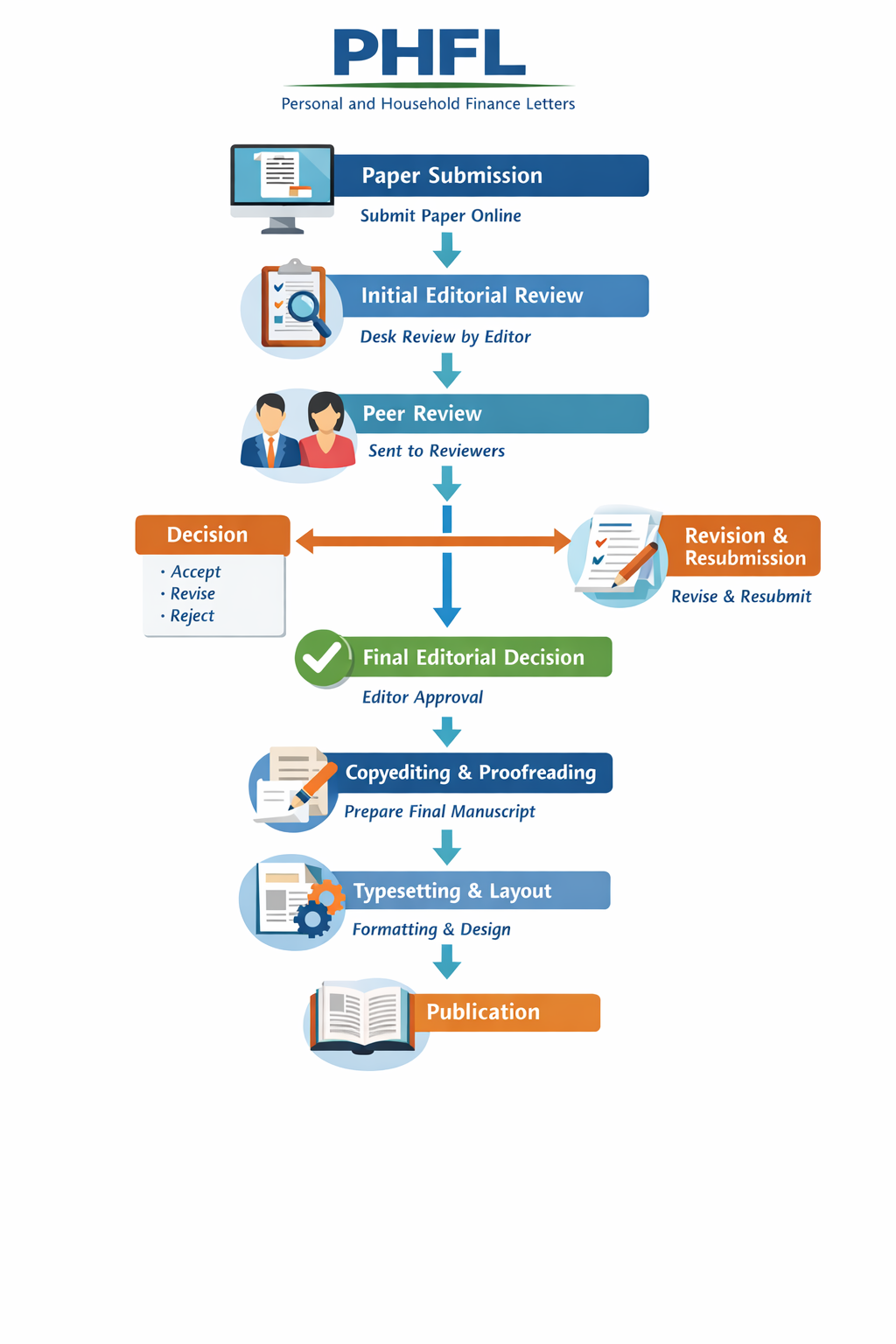
The PHFL publication process is illustrated below: