
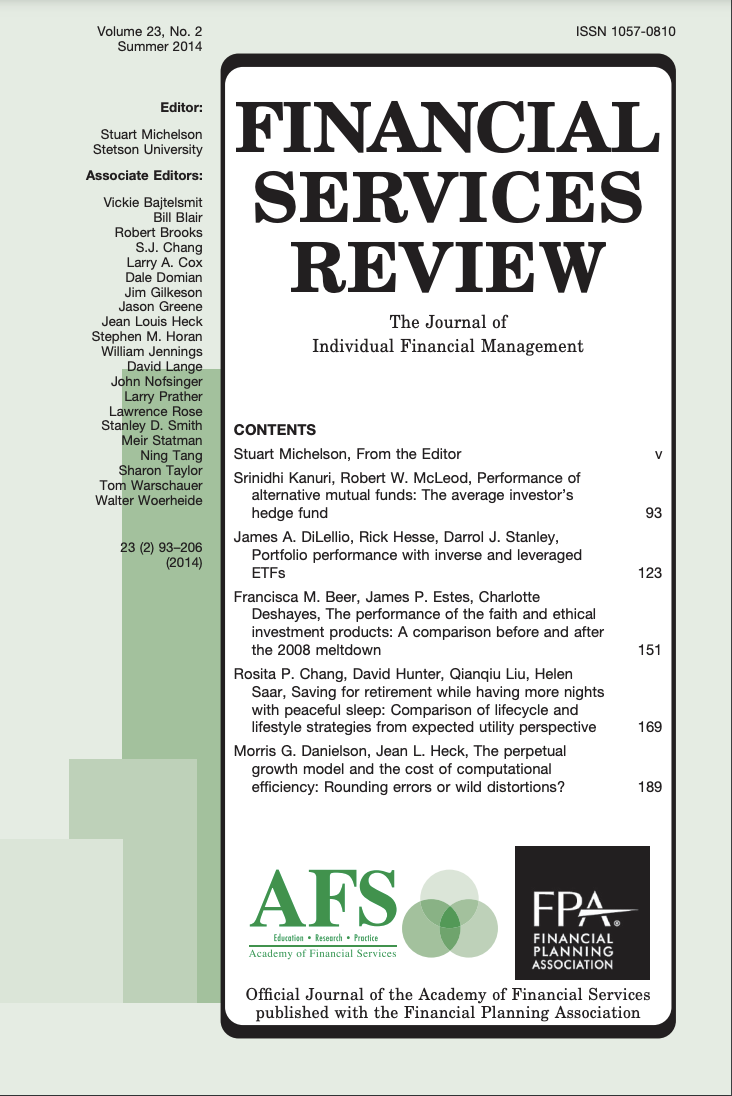
Portfolio performance with inverse and leveraged ETFs
DOI:
https://doi.org/10.61190/fsr.v23i2.3131Keywords:
Asset allocation, Portfolio, Diversification, Leveraged ETFs, Inverse ETFsAbstract
Turbulent economic and financial times require investors and financial planners to investigate new ways to handle the goal of wealth maximization. This article investigates passive investment strategies that use inverse or leveraged equity exchanged-traded funds (ETFs) in their asset allocation, and quantifies the long-term impact on portfolio performance for the purpose of improving the risk-reward tradeoff. Monte Carlo simulations are used, drawing samples from distributions created by two distinct time periods of historical daily market returns. The findings suggest that, whereas these products are generally not recommended within long-term passive investment strategies, potential diversification benefits exist, dependent on the behavior of equity and debt markets. These findings could materially alter long-term passive portfolio construction methods currently in use by financial planners and individual investors seeking potential diversification benefits using ETFs.
Downloads
Downloads
Published
Issue
Section
License
Copyright (c) 2014 Academy of Financial Services

This work is licensed under a Creative Commons Attribution-NonCommercial 4.0 International License.
Author(s) retain the copyright and full publishing rights without restriction.
Author(s) grant the Journal right of first publication with the work simultaneously licensed under a Creative Commons Attribution-NonCommercial 4.0 International License that allows reusers to distribute, remix, adapt, and build upon the material in any medium or format, for noncommercial purposes only. Reusers must acknowledge the work's authorship and initial publication in this Journal.
Noncommercial means not primarily intended for or directed towards commercial advantage or monetary compensation.
In addition, FSR grants to the UGA Libraries a worldwide, non-exclusive license to all content published by the Journal, including metadata, that is necessary to publish, transmit, and index the Journal and to preserve its content over time.