
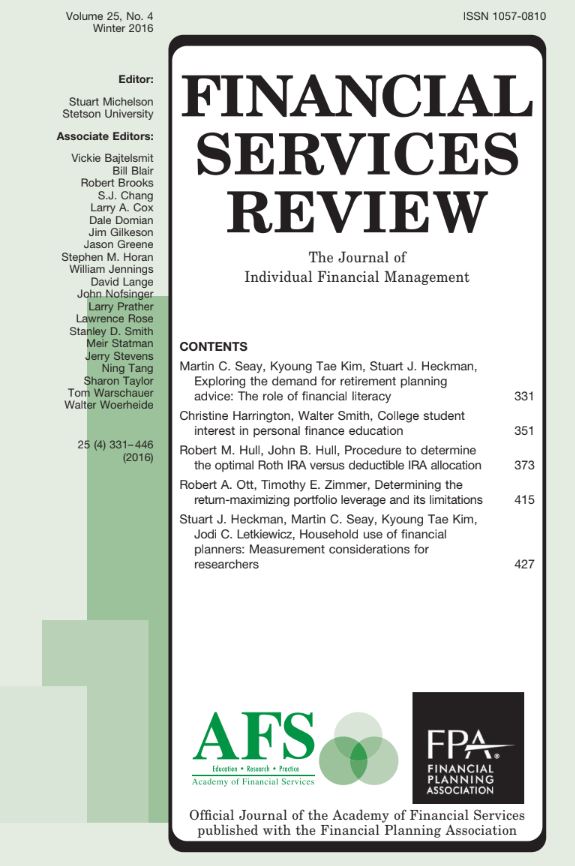
Determining the return-maximizing portfolio leverage and its limitations
DOI:
https://doi.org/10.61190/fsr.v25i4.3287Keywords:
Investment, Leverage, Investment returns, Return-maximizing investment leverageAbstract
Leverage in the risk allocation of an investment portfolio can be an effective strategy in achieving overall portfolio goals. While the literature on portfolio leverage is robust, quantifying the amount and discussion of its limitations are often minimized. This article focuses on the limitations by explicitly including the volatility drag from leveraging the expected portfolio returns. Maximizing the expected portfolio returns with respect to leverage results in a return-maximizing condition that balances the gains from leverage with the losses in the volatility drag. The return-maximizing condition is graphically illustrated over a range of investment returns to produce a return-maximizing leverage curve.
Downloads
Downloads
Published
Issue
Section
License
Copyright (c) 2014 Academy of Financial Services

This work is licensed under a Creative Commons Attribution-NonCommercial 4.0 International License.
Author(s) retain the copyright and full publishing rights without restriction.
Author(s) grant the Journal right of first publication with the work simultaneously licensed under a Creative Commons Attribution-NonCommercial 4.0 International License that allows reusers to distribute, remix, adapt, and build upon the material in any medium or format, for noncommercial purposes only. Reusers must acknowledge the work's authorship and initial publication in this Journal.
Noncommercial means not primarily intended for or directed towards commercial advantage or monetary compensation.
In addition, FSR grants to the UGA Libraries a worldwide, non-exclusive license to all content published by the Journal, including metadata, that is necessary to publish, transmit, and index the Journal and to preserve its content over time.