
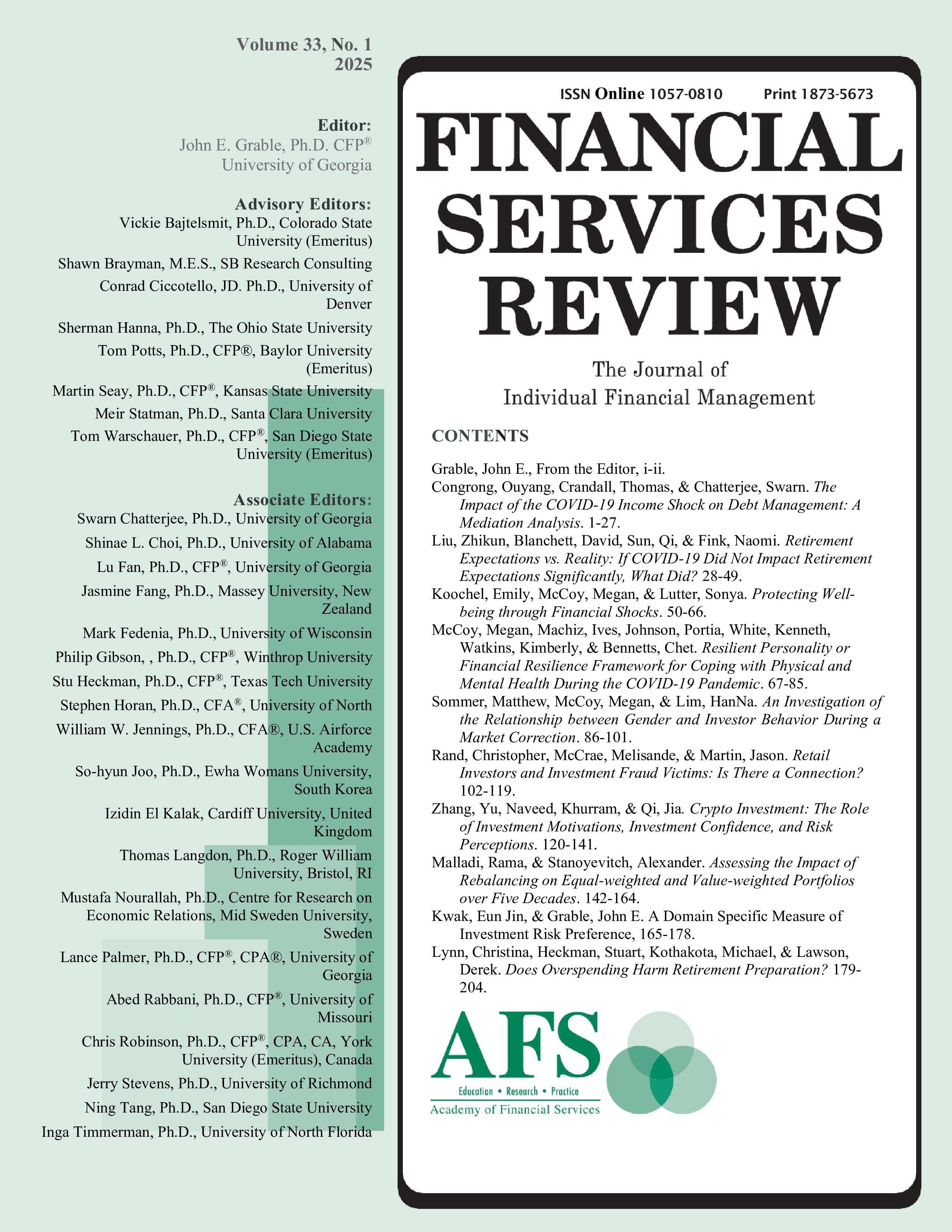
Protecting Well-Being through Financial Shocks
DOI:
https://doi.org/10.61190/fsr.v33i1.3640Keywords:
Financial Wellbeing, Financial Stress, Coping, Financial Shock, Financial SocializationAbstract
The ability to provide more than problem-solving interventions is useful in reducing client stress. Protective features can be built and amplified during financial uncertainty that may increase individuals’ resilience against factors that have the potential to cause damage to their financial well-being. To understand the predictive relationship between financial stressors, prior financial experience and exposure, and resources impact on financial well-being, a three-model hierarchical multiple regression was conducted with financial well-being as the dependent variable. Greater availability of resources increased financial well-being above and beyond the effects of stressors and prior exposure and experience. However, it is important to note that greater availability of resources was not measured just by income, rather it was variables that assessed other forms of capital. Specifically, individual qualities such as self-control and perceived health positively contributed to financial well-being. Results indicate that maintaining financial well-being is about more than knowledge and skill. Increasing opportunities for financial socialization and building clients’ sense of control may serve as a key buffer during times of financial stress.
Downloads
Downloads
Published
Issue
Section
License
Copyright (c) 2024 Emily Koochel, Megan McCoy, Sonya Lutter

This work is licensed under a Creative Commons Attribution-NonCommercial 4.0 International License.
Author(s) retain the copyright and full publishing rights without restriction.
Author(s) grant the Journal right of first publication with the work simultaneously licensed under a Creative Commons Attribution-NonCommercial 4.0 International License that allows reusers to distribute, remix, adapt, and build upon the material in any medium or format, for noncommercial purposes only. Reusers must acknowledge the work's authorship and initial publication in this Journal.
Noncommercial means not primarily intended for or directed towards commercial advantage or monetary compensation.
In addition, FSR grants to the UGA Libraries a worldwide, non-exclusive license to all content published by the Journal, including metadata, that is necessary to publish, transmit, and index the Journal and to preserve its content over time.