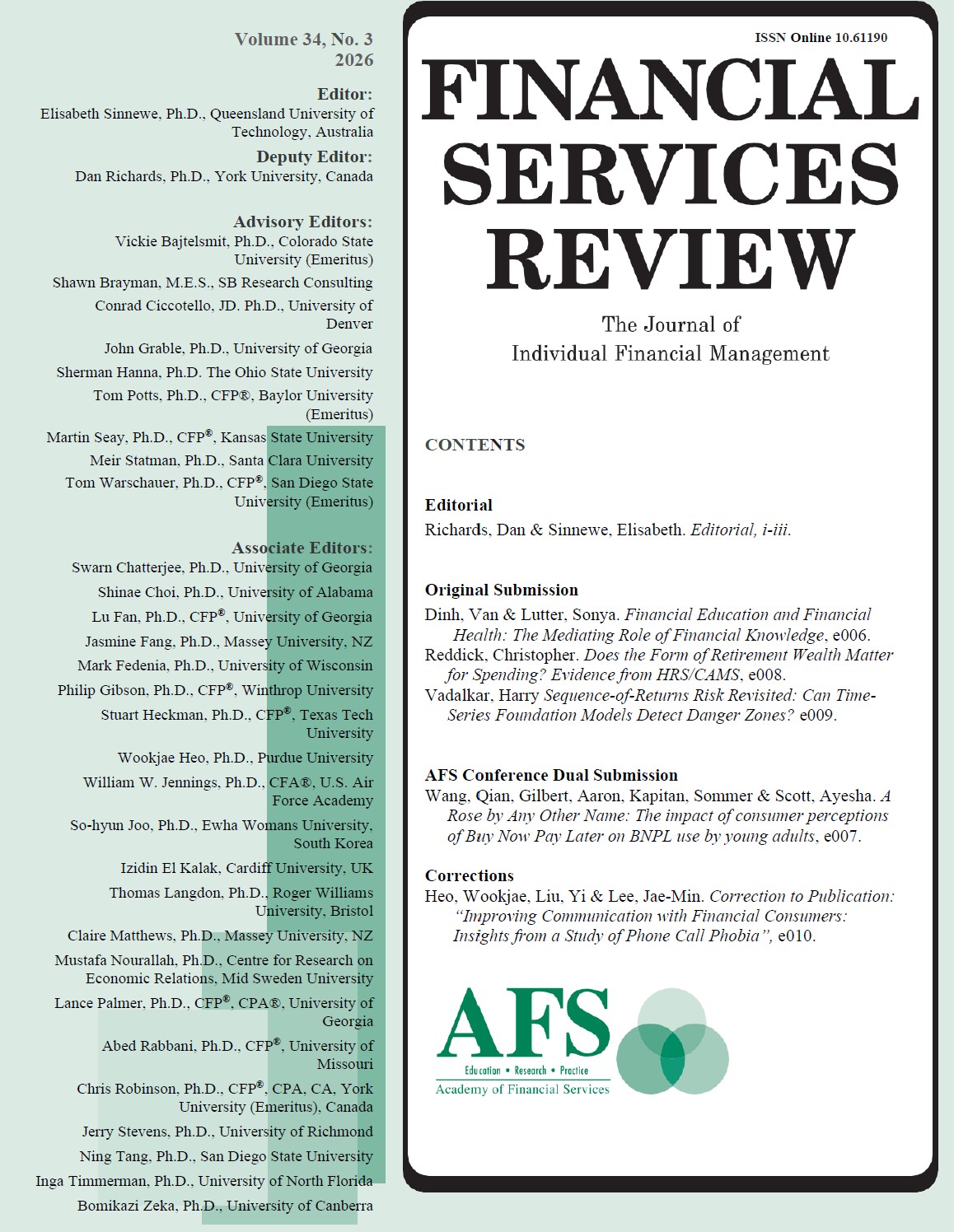
A Rose by Any Other Name: The impact of consumer perceptions of Buy Now Pay Later on BNPL use by young adults
DOI:
https://doi.org/10.61190/4d2qpg27Keywords:
Buy Now Pay Later, Consumer Perceptions, Debt Use, Young AdultsAbstract
This paper examines the relationship between consumers' perceptions of Buy Now Pay Later (BNPL) products and their subsequent usage patterns. Based on the literature on consumer perceptions, marketing strategies and financial product promotions, this study employs dual information processing theory as a lens for understanding how perceptions drive adoption and use of BNPL services. We employ ordered logistic regressions to analyse responses from a survey of young consumers aged 18-34 in New Zealand conducted by Qualtrics to assess the impact of consumer perceptions of BNPL across multiple aspects on frequency of use, whether consumers borrow to repay BNPL, and frequency of incurring late fees. The main findings suggest that marketing strategies significantly influence consumers' perceptions of BNPL, which in turn significantly affects their usage behaviour. Specifically, consumer acceptance of the attractive features of BNPL appears to mask the financial risks involved, relating to greater use and use consistent with impulse purchasing and possible subsequent debt accumulation.
Downloads
References
Aalders, R. (2023). Buy now, pay later: redefining indebted users as responsible consumers. Information, Communication & Society, 26(5), 941-956. https://doi.org/10.1080/1369118X.2022.2161830 DOI: https://doi.org/10.1080/1369118X.2022.2161830
Ackert, L. F., Khayati, A., & Kelani, Z. (2025). Buy Now, Pay Later Loans, Social Norms, and Consumer Indebtedness. Journal of Behavioral Finance, 26(4), 558–569. https://doi.org/10.1080/15427560.2024.2385898 DOI: https://doi.org/10.1080/15427560.2024.2385898
Afterpay. (2023a). Does Afterpay conduct credit checks? Retrieved November 10, 2023, from https://help.afterpay.com/hc/en-us/articles/4487846176793-Does-Afterpay-conduct-credit-checks-
Afterpay. (2023b). Is there a cost to using Afterpay? Retrieved November 10, 2023, from https://help.afterpay.com/hc/en-us/articles/218320423-Is-there-a-cost-to-using-Afterpay
Afterpay. (2023c). Terms of Service - New Zealand. Retrieved November 10, 2023, from https://www.afterpay.com/en-NZ/terms-of-service
Ah Fook, L., & McNeill, L. (2020). Click to buy: The impact of retail credit on over-consumption in the online environment. Sustainability, 12(18), 7322. https://doi.org/10.3390/su12187322 DOI: https://doi.org/10.3390/su12187322
ASIC (Australian Securities and Investments Commission). (2020). Buy now pay later: An industry update (Report 672). https://asic.gov.au/regulatory-resources/find-a-document/reports/rep-672-buy-now-pay-later-an-industry-update
Autoriteit Financiële Markten (AFM). (2025, June). Buy now, pay later market update 2025. AFM. https://www.afm.nl/~/profmedia/files/rapporten/2025/bnpl-marketupdate.pdf
Bargh, J. A., & Chartrand, T. L. (1999). The unbearable automaticity of being. American Psychologist, 54(7), 462-479. https://psycnet.apa.org/doi/10.1037/0003-066X.54.7.462 DOI: https://doi.org/10.1037/0003-066X.54.7.462
Bea, M., & Bley, K. (2022). (Un)conditional consumer protections in high-cost lending regulation: Impacts on local lending geographies. Journal of Consumer Affairs, 56(4), 1561–1596. https://doi.org/10.1111/joca.12481 DOI: https://doi.org/10.1111/joca.12481
Bourassa, S., & Shi, S. (2017). Understanding New Zealand’s decline in homeownership. Housing Studies, 32(5), 693–710. https://doi.org/10.1080/02673037.2016.1228851 DOI: https://doi.org/10.1080/02673037.2016.1228851
Chatterjee, P., & Rose, R. (2012). Do payment mechanisms change the way consumers perceive products? Journal of Consumer Research, 38(6), 1129-1139. https://doi.org/10.1086/661730 DOI: https://doi.org/10.1086/661730
Coffey, J., Senior, K., Haro, A., Farrugia, D., Threadgold, S., Cook, J., Davies, K., & Shannon, B. (2023). Embodying debt: Youth, consumer credit and its impacts for wellbeing. Journal of Youth Studies, 27(5), 685–705. https://doi.org/10.1080/13676261.2022.2162376 DOI: https://doi.org/10.1080/13676261.2022.2162376
Consumer NZ. (2022, October 31). Buy now pay later preys on the poorest consumers. https://www.consumer.org.nz/articles/buy-now-pay-later-preys-on-the-poorest-consumers
Consumer Financial Protection Bureau. (2023). Consumer use of buy now, pay later: Borrowing, repayment, and dispute experiences among buy now, pay later borrowers (CFPB Office of Research Publication No. 2023-1). https://files.consumerfinance.gov/f/documents/cfpb_consumer-use-of-buy-now-pay-later_2023-03.pdf
Dadra, R., Sonavane, A., Bachwani, S., & Behera, C. K. (2024). Beyond credit cards: A TEP perspective on buy-now-pay-later adoption. Journal of Global Scholars of Marketing Science, 34(4), 459–484. https://doi.org/10.1080/21639159.2024.2391282 DOI: https://doi.org/10.1080/21639159.2024.2391282
Dataintelo. (n.d.). Consumer finance market report. Dataintelo. Retrieved September 4, 2025, from https://dataintelo.com/report/consumer-finance-market
de Haan, E., Kim, J., Lourie, B., & Zhu, C. (2024). Buy Now Pay (Pain?) Later. Management Science 70(8), 5586-5598. https://doi.org/10.1287/mnsc.2022.03266 DOI: https://doi.org/10.1287/mnsc.2022.03266
Deloitte Australia. (2018). The digital consumer credit revolution: Buy now pay later and the new credit economy. Deloitte. https://www2.deloitte.com/au/en/pages/consumer-industrial-products/articles/digital-consumer-credit-revolution.html
Disney, R., & Gathergood, J. (2011). Financial literacy and indebtedness: New evidence for UK consumers (Discussion Paper No. 11/05). University of Nottingham. https://www.nottingham.ac.uk/cfcm/documents/papers/11-05.pdf DOI: https://doi.org/10.2139/ssrn.1851343
Duong, L., Taylor, G., & Eulaiw, B. (2022). Comparative analysis of credit card interest rates vs BNPL fees in the consumer credit market. Financial Counselling Australia. https://www.financialcounsellingaustralia.org.au/docs/comparative-analysis-of-credit-card-interest-rates-vs-bnpl-fees
Fintech Futures. (2025, January 27). Buy now, pay later global business report 2025: BNPL payments to grow by 13.7% to surpass $560 billion this year, driven by Klarna, Afterpay, PayPal and Affirm, forecast to 2030. Fintech Futures. https://www.fintechfutures.com/press-releases/buy-now-pay-later-global-business-report-2025-bnpl-payments-to-grow-by-13-7-to-surpass-560-billion-this-year-driven-by-klarna-afterpay-paypal-and-affirm-forecast-to-2030
Fresco, N. (2022). Information in Explaining Cognition: How to Evaluate It? Philosophies, 7(2), 28. https://doi.org/10.3390/philosophies7020028 DOI: https://doi.org/10.3390/philosophies7020028
Galariotis, N., & Monne, J. (2023). Basic debt literacy and debt behavior. International Review of Financial Analysis, 88, 102673. https://doi.org/10.1016/j.irfa.2023.102673 DOI: https://doi.org/10.1016/j.irfa.2023.102673
Garg, N., & Singh, S. (2018). Financial literacy among youth. International Journal of Social Economics, 45(1), 173–186. https://doi.org/10.1108/IJSE-11-2016-0303 DOI: https://doi.org/10.1108/IJSE-11-2016-0303
Gębski, Ł., Daw, G., Waliszewski, K., Folwarski, M., & Druhov, O. (2025). Could the Popularity of BNPL Result from Consumers' Misconceptions about the Financial Product's? Studia z Polityki Publicznej/Public Policy Studies, 12(3), 121-147. https://doi.org/10.33119/KSzPP/2025.3.6 DOI: https://doi.org/10.33119/KSzPP/2025.3.6
Gerrans, P., Baur, D. G., & Lasagna-Slater, S. (2022a). Fintech and responsibility: Buy-now-pay-later arrangements. Australian Journal of Management, 47(3), 474-502. https://doi.org/10.1177/03128962211032448 DOI: https://doi.org/10.1177/03128962211032448
Gerrans, P., Heaney, R., & Xu, M. (2022b). The substitution of credit cards with buy now pay later: Evidence from Australia. Accounting & Finance, 62(3), 3757–3785. https://doi.org/10.1111/acfi.12891 DOI: https://doi.org/10.1111/acfi.12891
Graeber, D. (2012). Debt: The first 5000 years. Penguin UK. Retrieved from https://warwick.ac.uk/fac/arts/english/currentstudents/undergraduate/modules/fulllist/special/statesofdamage/syllabus201516/graeber-debt_the_first_5000_years.pdf
Guttman-Kenney, B., Firth, C., & Gathergood, J. (2023). Buy now, pay later (BNPL) ...on your credit card, Journal of Behavioral and Experimental Finance, 37, 100788. https://doi.org/10.1016/j.jbef.2023.100788 DOI: https://doi.org/10.1016/j.jbef.2023.100788
Hung, K. (2024, July 29). Understanding the appeal of buy now pay later. Forbes. https://www.forbes.com/sites/kevinhung/2024/07/29/understanding-the-appeal-of-buy-now-pay-later/
Johnson, D., Rodwell, J., & Hendry, T. (2021). Analyzing the impacts of financial services regulation to make the case that buy-now-pay-later regulation is failing. Sustainability, 13(4), 1992. https://doi.org/10.3390/su13041992 DOI: https://doi.org/10.3390/su13041992
Kahneman, D., & Frederick, S. (2002). Representativeness revisited: Attribute substitution in intuitive judgment. In T. Gilovich, D. Griffin, & D. Kahneman (Eds.), Heuristics and biases: The psychology of intuitive judgment, 49 (49-81). https://doi.org/10.1017/CBO9780511808098.004 DOI: https://doi.org/10.1017/CBO9780511808098.004
Kohere, R. (2022, July 11). Liquor stores offering Afterpay is only the beginning, experts warn. The Spinoff. https://thespinoff.co.nz/business/12-07-2022/liquor-stores-offering-afterpay-is-only-the-beginning-experts-warn
Kumar, J., & Rani, V. (2024). Investigating the dynamics of FinTech adoption: An empirical study from the perspective of mobile banking. Journal of Economic and Administrative Sciences. 42(1), 123-140. https://doi.org/10.1108/JEAS-12-2023-0334 DOI: https://doi.org/10.1108/JEAS-12-2023-0334
Laybuy. (2020). Buy now pay later: Submission. Ministry of Business, Innovation, and Employment. Retrieved from https://www.mbie.govt.nz/dmsdocument/19044-laybuy-buy-now-pay-later-submission-pdf
Lee. Y. I., & Trim, P. R. (2022). Enhancing marketing provision through increased online safety that imbues consumer confidence: coupling AI and ML with the AIDA Model. Big Data and Cognitive Computing, 6(3), 78. https://doi.org/10.3390/bdcc6030078 DOI: https://doi.org/10.3390/bdcc6030078
Lim, T., Pan, T., Ong, C. S., Chen, S., & Chia, J. J. J. (2023). Theory-Guided Analytics Process: Using Theories to Underpin an Analytics Process for New Banking Product Development Using Segmentation-Based Marketing Analytics Leveraging on Marketing Intelligence. Analytics, 2(1), 105-131. https://doi.org/10.3390/analytics2010007 DOI: https://doi.org/10.3390/analytics2010007
Lučić, A., Barbić, D., & Uzelac, M. (2023). Theoretical underpinnings of consumers’ financial capability research. International Journal of Consumer Studies, 47(1), 373-399. https://doi.org/10.1111/ijcs.12778 DOI: https://doi.org/10.1111/ijcs.12778
Lusardi, A. (2011). Americans' financial capability (No. w17103). National Bureau of Economic Research. https://doi.org/10.3386/w17103 DOI: https://doi.org/10.3386/w17103
Lusardi, A., & Tufano, P. (2015). Debt literacy, financial experiences, and over indebtedness. Journal of Pension Economics and Finance, 14(4), 332–368. https://doi.org/10.1017/S1474747215000232 DOI: https://doi.org/10.1017/S1474747215000232
Martin, T., Sam, J., & Gibson, P. (2021). Financial Literacy to Prevent Poor Borrowing Choices. Financial Services Review, 29, 293-314. https://doi.org/10.61190/fsr.v29i4.3464 DOI: https://doi.org/10.61190/fsr.v29i4.3464
Mazar, N., Plassmann, H., Robitaille, N., & Lindner, A. (2016). Pain of paying? —A metaphor gone literal: Evidence from neural and behavioral science. Rotman School of Management Working Paper, (2901808). DOI: https://doi.org/10.2139/ssrn.2901808
Ministry of Business, Innovation and Employment. (2021). Discussion document: Buy now, pay later - Understanding the triggers of financial hardship and possible options to address them. Retrieved fromhttps://www.mbie.govt.nz/dmsdocument/17817-discussion-document-buy-now-pay-later-understanding-the-triggers-of-financial-hardship-and-possible-options-to-address-them
Muradoglu, G., Harvey, N., Pattarin, F., & Cosma, S. (2012). Psychological determinants of consumer credit: The role of attitudes. Review of Behavioral Finance, 4(2), 113–129. https://doi.org/10.1108/19405971211284899 DOI: https://doi.org/10.1108/19405971211284899
Pisani, F., & Atalay, S. (2018). Cashless payments, pain of paying and the role of attachment. European Advances in Consumer Research, 11, 238–239.
PYMNTS. (2022). More than half of merchants raise conversion, brand awareness with BNPL. PYMNTS.com. Retrieved from https://www.pymnts.com/buy-now-pay-later/2022/more-than-half-of-merchants-raise-conversion-brand-awareness-with-bnpl/
Raj, R., Patel, V., & Singh, A. (2023). Impulsive and compulsive spending in the era of buy now pay later: A behavioral finance perspective. Journal of Behavioral and Experimental Finance, 39, 100778. https://doi.org/10.1016/j.jbef.2023.100778
Sawatzki, C., Gerrans, P., Muir, K., & Ali, S. (2020). Young Australians and the new landscape of credit: Perspectives on buy now pay later and other consumer credit products. Australian Journal of Social Issues, 55(4), 409–428. https://doi.org/10.1002/ajs4.122 DOI: https://doi.org/10.1002/ajs4.122
Schomburgk, L., & Hoffmann, A. (2023). How mindfulness reduces BNPL usage and how that relates to overall well-being. European Journal of Marketing, 57(2), 325–359. https://doi.org/10.1108/EJM-11-2021-0923 DOI: https://doi.org/10.1108/EJM-11-2021-0923
Soman, D. (2001). Effects of payment mechanism on spending behavior: The role of rehearsal and immediacy of payments. Journal of Consumer Research, 27(4), 460-474. https://doi.org/10.1086/319621 DOI: https://doi.org/10.1086/319621
Worldpay, LLC. (2024). The global payments report 2024. Worldpay. https://worldpay.globalpaymentsreport.com/en
Yu, T. K., & Fang, K. (2009). Measuring the post-adoption customer perception of mobile banking services. CyberPsychology & Behavior, 12(1), 33-35. https://doi.org/10.1089/cpb.2007.0209 DOI: https://doi.org/10.1089/cpb.2007.0209
Downloads
Published
Issue
Section
License
Copyright (c) 2026 Qian Wang, Aaron Gilbert, Sommer Kapitan, Ayesha Scott

This work is licensed under a Creative Commons Attribution-NonCommercial 4.0 International License.
Author(s) retain the copyright and full publishing rights without restriction.
Author(s) grant the Journal right of first publication with the work simultaneously licensed under a Creative Commons Attribution-NonCommercial 4.0 International License that allows reusers to distribute, remix, adapt, and build upon the material in any medium or format, for noncommercial purposes only. Reusers must acknowledge the work's authorship and initial publication in this Journal.
Noncommercial means not primarily intended for or directed towards commercial advantage or monetary compensation.
In addition, FSR grants to the UGA Libraries a worldwide, non-exclusive license to all content published by the Journal, including metadata, that is necessary to publish, transmit, and index the Journal and to preserve its content over time.