
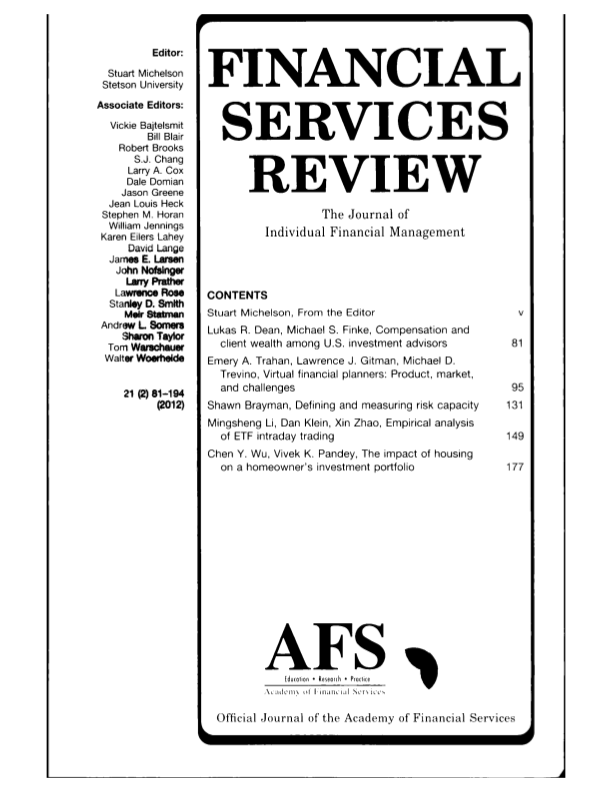
Compensation and client wealth among U.S. investment advisors
DOI:
https://doi.org/10.61190/fsr.v21i2.4666Keywords:
Fiduciary, Client, Conflict, Commission, CompensationAbstract
This study uses disclosure data from 7,043 Registered Investment Advisors (RIAs) in the United States to examine differences in client wealth by type of compensation. Results suggest that firms charging commissions and hourly fees have a higher proportion of low net worth clients. Wealthier clients are more likely to be charged performance-based fees and fees based on assets under management. RIA firms that charge commissions are more likely to provide financial planning services in addition to investment advice. Results suggest that policy restricting compensation may impact the provision of advising services to average investors.
Downloads
Downloads
Published
Issue
Section
License
Copyright (c) 2012 Academy of Financial Services

This work is licensed under a Creative Commons Attribution-NonCommercial 4.0 International License.
Author(s) retain the copyright and full publishing rights without restriction.
Author(s) grant the Journal right of first publication with the work simultaneously licensed under a Creative Commons Attribution-NonCommercial 4.0 International License that allows reusers to distribute, remix, adapt, and build upon the material in any medium or format, for noncommercial purposes only. Reusers must acknowledge the work's authorship and initial publication in this Journal.
Noncommercial means not primarily intended for or directed towards commercial advantage or monetary compensation.
In addition, FSR grants to the UGA Libraries a worldwide, non-exclusive license to all content published by the Journal, including metadata, that is necessary to publish, transmit, and index the Journal and to preserve its content over time.