
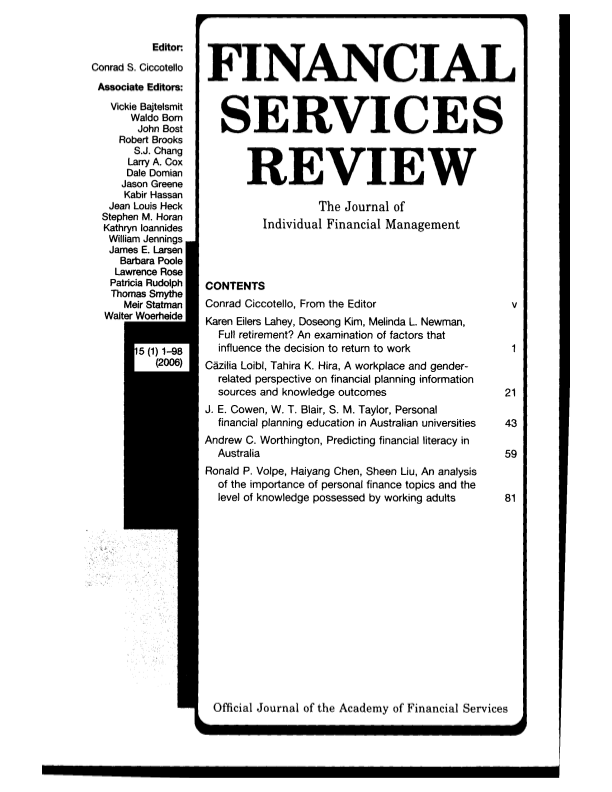
Predicting financial literacy in Australia
DOI:
https://doi.org/10.61190/fsr.v15i1.4843Keywords:
Financial characteristics, Socioeconomic, Demographic, Ordered logit, Financial literacyAbstract
Logit models are used to predict financial literacy using the 2003 ANZ Survey of Adult Financial Literacy in Australia. Financial literacy is defined in terms of mathematical ability and the under standing of financial terms. Factors examined include gender, age, ethnicity, occupation, education, income, savings, and debt. Financial literacy is found to be highest for persons aged between 50 and 60 years, professionals, business and farm owners, and university/college graduates. Literacy is lowest for the unemployed, females, and those from a non-English speaking background with a low level of education.
Downloads
Downloads
Published
Issue
Section
License
Copyright (c) 2006 Academy of Financial Services

This work is licensed under a Creative Commons Attribution-NonCommercial 4.0 International License.
Author(s) retain the copyright and full publishing rights without restriction.
Author(s) grant the Journal right of first publication with the work simultaneously licensed under a Creative Commons Attribution-NonCommercial 4.0 International License that allows reusers to distribute, remix, adapt, and build upon the material in any medium or format, for noncommercial purposes only. Reusers must acknowledge the work's authorship and initial publication in this Journal.
Noncommercial means not primarily intended for or directed towards commercial advantage or monetary compensation.
In addition, FSR grants to the UGA Libraries a worldwide, non-exclusive license to all content published by the Journal, including metadata, that is necessary to publish, transmit, and index the Journal and to preserve its content over time.