
An alternative approach to after-tax valuation
DOI:
https://doi.org/10.61190/fsr.v16i3.4888Keywords:
Withdrawals, 401(k), IRA, Estate planning, Tax planning, Retirement planningAbstract
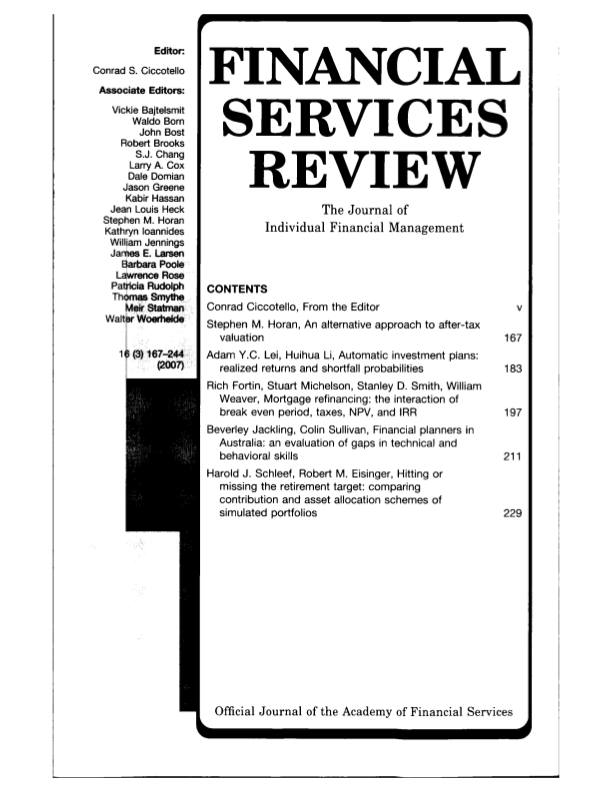
Reichenstein (2001, 2007) argues that the type of savings account in which an asset is held affects the after-tax return received by and after-tax risk borne by investors. He uses this powerful insight to develop the notion of after-tax asset values that are predicated on an asset’s current after-tax consumption value. This paper builds on the risk-sharing insight and approaches after-tax asset valuation from an investment perspective based on future benefits. It also extends the model to accommodate a broader array of more realistic taxation environments. Examples of after-tax optimi- zation indicate that the recommended asset disposition depends heavily on the model chosen.
Downloads
Downloads
Published
Issue
Section
License
Copyright (c) 2007 Academy of Financial Services

This work is licensed under a Creative Commons Attribution-NonCommercial 4.0 International License.
Author(s) retain the copyright and full publishing rights without restriction.
Author(s) grant the Journal right of first publication with the work simultaneously licensed under a Creative Commons Attribution-NonCommercial 4.0 International License that allows reusers to distribute, remix, adapt, and build upon the material in any medium or format, for noncommercial purposes only. Reusers must acknowledge the work's authorship and initial publication in this Journal.
Noncommercial means not primarily intended for or directed towards commercial advantage or monetary compensation.
In addition, FSR grants to the UGA Libraries a worldwide, non-exclusive license to all content published by the Journal, including metadata, that is necessary to publish, transmit, and index the Journal and to preserve its content over time.