
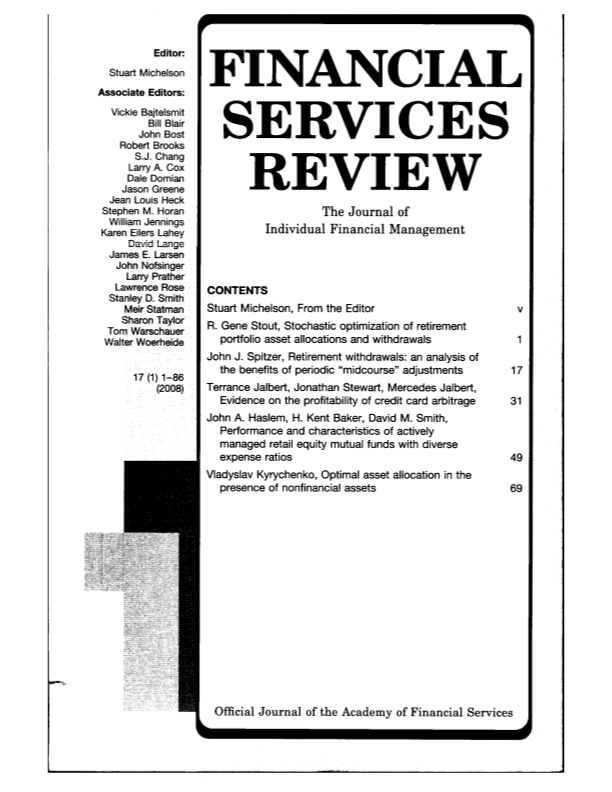
Retirement withdrawals
an analysis of the benefits of periodic “midcourse” adjustments
DOI:
https://doi.org/10.61190/fsr.v17i1.4903Keywords:
Bootstrap, Asset allocation, Withdrawals, RetirementAbstract
Much research has addressed the question of how much money can safely be withdrawn from a retirement portfolio without prematurely running out of money (shortfall risk). Instead of constant (inflation adjusted) annual withdrawals, this study uses withdrawal amounts (and optionally, asset allocations) that are modified every five years over a 30-year withdrawal horizon. A bootstrap is used initially to obtain the conditional probability rules. Further simulations demonstrate that periodic (every five years) adjustments can decrease the risk of running out of money as well as increase the amount withdrawn, as compared to a “constant withdrawal amount” strategy.
Downloads
Downloads
Published
Issue
Section
License
Copyright (c) 2008 Academy of Financial Services

This work is licensed under a Creative Commons Attribution-NonCommercial 4.0 International License.
Author(s) retain the copyright and full publishing rights without restriction.
Author(s) grant the Journal right of first publication with the work simultaneously licensed under a Creative Commons Attribution-NonCommercial 4.0 International License that allows reusers to distribute, remix, adapt, and build upon the material in any medium or format, for noncommercial purposes only. Reusers must acknowledge the work's authorship and initial publication in this Journal.
Noncommercial means not primarily intended for or directed towards commercial advantage or monetary compensation.
In addition, FSR grants to the UGA Libraries a worldwide, non-exclusive license to all content published by the Journal, including metadata, that is necessary to publish, transmit, and index the Journal and to preserve its content over time.