
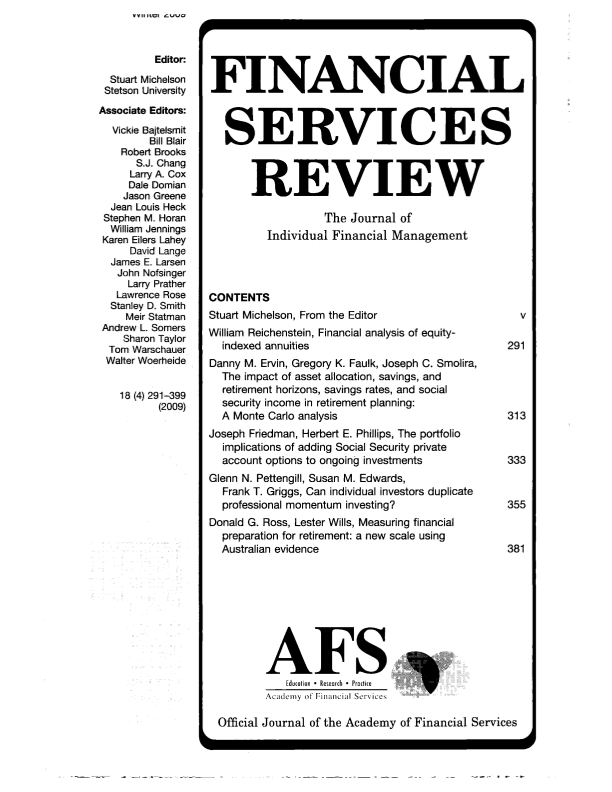
The portfolio implications of adding Social Security private account options to ongoing investments
DOI:
https://doi.org/10.61190/fsr.v18i4.4955Keywords:
Retirement annuities, Portfolio optimization, Social security benefits, Social security private accountsAbstract
Proposals to allow private accounts under Social Security were introduced long before George Bush was elected President, and support for privatization in some form will survive his administration and the economic downturn that followed. This paper studies the impact that private accounts would have on risk/return investment tradeoffs available to Social Security participants who save and invest on an ongoing basis outside the Social Security system. For such investor/participants, we show that the reduction in total diversifiable risk afforded by traditional Social Security accounts would be more than sufficient in many cases to compensate for the opportunity cost of opting-out of a privatization program if one were enacted. The risk of financing private accounts by diverting mandatory contributions away from guaranteed benefit accounts, on the other hand, would be proportionately higher for those with little or no private savings or investments outside the Social Security system. The paper concludes, therefore, that privatization would lead to imprudent risks being borne by those who can least afford to do so, and would offer no significant advantage to others.
Downloads
Downloads
Published
Issue
Section
License
Copyright (c) 2009 Academy of Financial Services

This work is licensed under a Creative Commons Attribution-NonCommercial 4.0 International License.
Author(s) retain the copyright and full publishing rights without restriction.
Author(s) grant the Journal right of first publication with the work simultaneously licensed under a Creative Commons Attribution-NonCommercial 4.0 International License that allows reusers to distribute, remix, adapt, and build upon the material in any medium or format, for noncommercial purposes only. Reusers must acknowledge the work's authorship and initial publication in this Journal.
Noncommercial means not primarily intended for or directed towards commercial advantage or monetary compensation.
In addition, FSR grants to the UGA Libraries a worldwide, non-exclusive license to all content published by the Journal, including metadata, that is necessary to publish, transmit, and index the Journal and to preserve its content over time.