
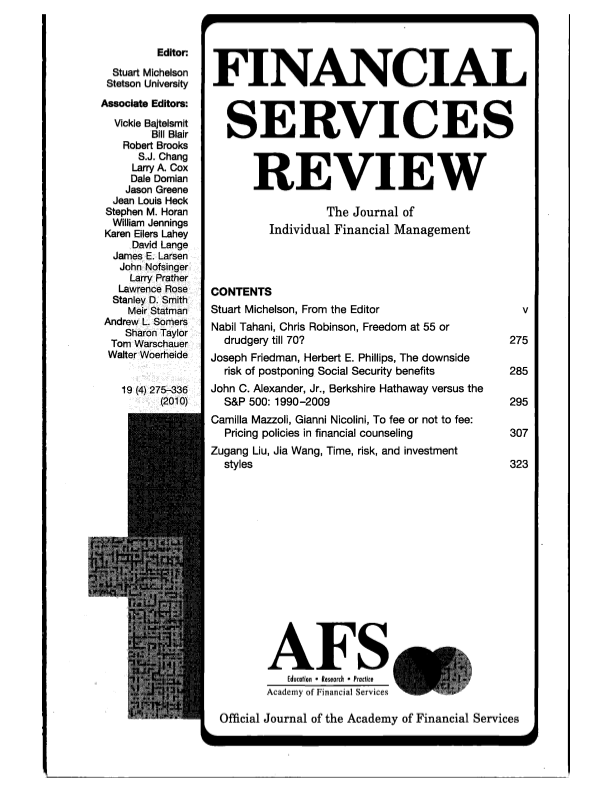
The downside risk of postponing Social Security benefits
DOI:
https://doi.org/10.61190/fsr.v19i4.4985Keywords:
Social Security, Social Security benefits initiation, Social Security benefit postponement, Social Security benefit optimization, Retirement annuitiesAbstract
The point that only life participants may initiate or receive Social Security benefits is typically overlooked. Thus, a postponement of benefits at any eligible retirement age may be likened to participation in a game of chance in which the participant is subject to a variant form of the gambler's ruin at death. The typical assumption, therefore, that a participant should automatically opt for a postponement if the present value of the resulting benefits, discounted to breakeven age, higher than the present value of the oppotunity costs, carries with it the implication of risk neutrality in relation to the consequence of dying before reaching the breakeven death age. While this implication of risk neutrality is sometimes correct, it is more likely not. In marked contrast to conclusions reached in previous studies, this paper shows that a single Social Security participant, who is risk averse as regards the chances - and contingent consequences - of dying before reaching breakeven age, would be well advised to initiate benefits at the earliest age at which he or she would not be subject to earned income penalties.
Downloads
Downloads
Published
Issue
Section
License
Copyright (c) 2010 Academy of Financial Services

This work is licensed under a Creative Commons Attribution-NonCommercial 4.0 International License.
Author(s) retain the copyright and full publishing rights without restriction.
Author(s) grant the Journal right of first publication with the work simultaneously licensed under a Creative Commons Attribution-NonCommercial 4.0 International License that allows reusers to distribute, remix, adapt, and build upon the material in any medium or format, for noncommercial purposes only. Reusers must acknowledge the work's authorship and initial publication in this Journal.
Noncommercial means not primarily intended for or directed towards commercial advantage or monetary compensation.
In addition, FSR grants to the UGA Libraries a worldwide, non-exclusive license to all content published by the Journal, including metadata, that is necessary to publish, transmit, and index the Journal and to preserve its content over time.