
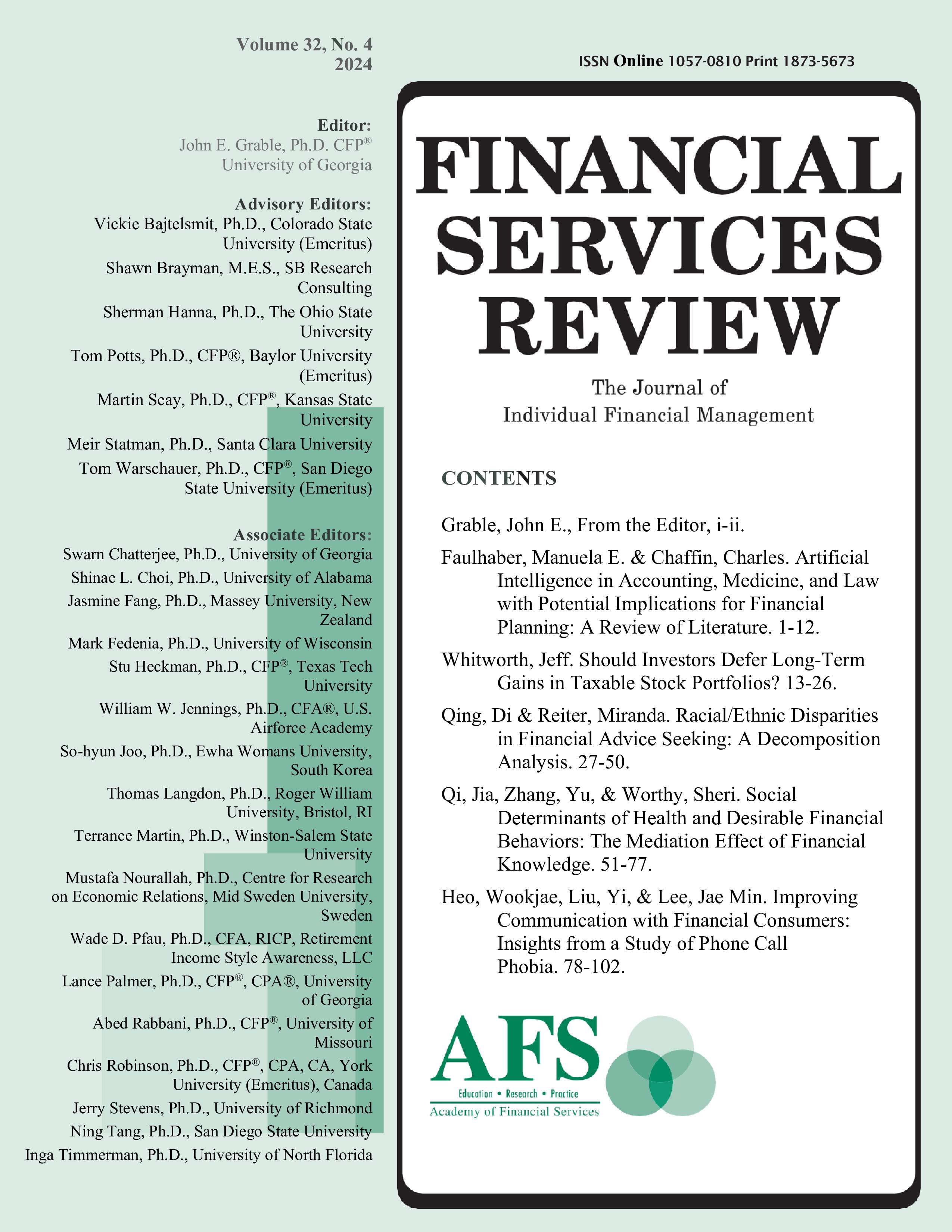
Racial/Ethnic Disparities in Financial Advice Seeking: A Decomposition Analysis
DOI:
https://doi.org/10.61190/fsr.v32i4.3355Keywords:
Decomposition, Financial Planning, Personal Finance, Racial/ethnic InequityAbstract
Financial advice seeking is associated with many positive benefits for consumers. Yet, most U.S. households are not working with a financial planner and research has pointed to the lack of racial and ethnic diversity among those who do. This study examines racial/ethnic disparities in using a financial planner. Logistic regression analyses show that Black and White consumers are more likely than Asian and Hispanic consumers to use financial planners for saving and investment decisions. A Fairlie decomposition analysis shows racial/ethnic differences among the determinants that are associated with financial advice seeking. The differences in the determinants were large between White and Hispanic consumers and much narrower between Black and Hispanic consumers. Risk tolerance, objective financial knowledge, and income were the most important determinants to explain racial/ethnic differences in financial planner use. This study provides insight into possible barriers to working with financial planners for a diverse group of consumers.
Downloads
Downloads
Published
Issue
Section
License
Copyright (c) 2024 Di Qing, Miranda Reiter

This work is licensed under a Creative Commons Attribution-NonCommercial 4.0 International License.
Author(s) retain the copyright and full publishing rights without restriction.
Author(s) grant the Journal right of first publication with the work simultaneously licensed under a Creative Commons Attribution-NonCommercial 4.0 International License that allows reusers to distribute, remix, adapt, and build upon the material in any medium or format, for noncommercial purposes only. Reusers must acknowledge the work's authorship and initial publication in this Journal.
Noncommercial means not primarily intended for or directed towards commercial advantage or monetary compensation.
In addition, FSR grants to the UGA Libraries a worldwide, non-exclusive license to all content published by the Journal, including metadata, that is necessary to publish, transmit, and index the Journal and to preserve its content over time.