
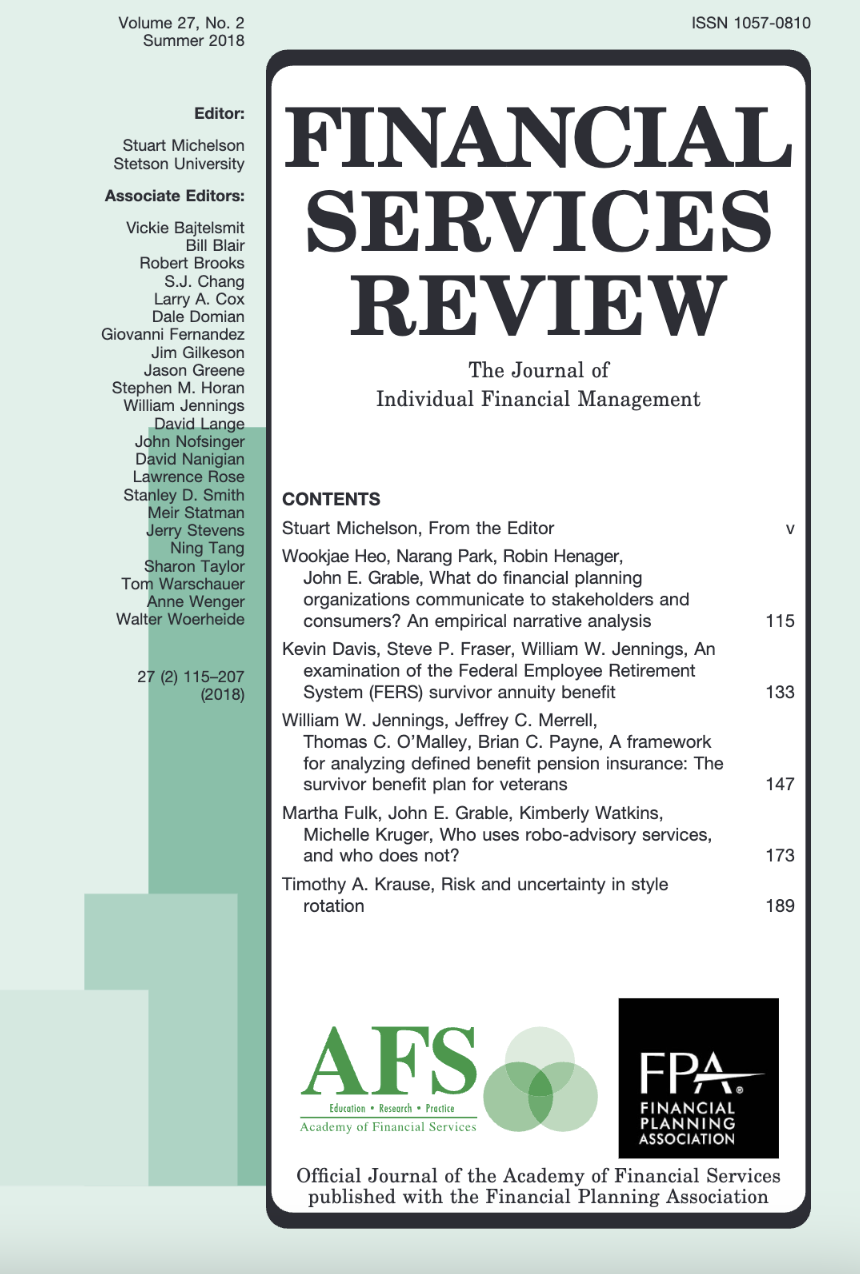
Who uses robo-advisory services, and who does not?
DOI:
https://doi.org/10.61190/fsr.v27i2.3390Keywords:
Robo-advisor, Robo-advisory services, Financial planner, Financial planningAbstract
The purpose of this study was to compare the demographic, attitudinal, and behavioral character- istics of U.S. consumers in their current and expected use of robo-advisory services, traditional financial planning services, or a combination of the two services. Findings showed a difference between those who used robo-advisory services and those who used traditional financial planning services. Overall, those who used a traditional financial planner were older and reported higher levels of net worth, while users of robo-advisors, on average, reported lower levels of net worth. In addition, those who used traditional financial planning services reported a larger percentage of their total net worth from an inheritance, whereas a lower percentage of net worth from an inheritance was reported by robo-advisor users. Results showed that users of robo-advisory services generally (1) had lower income, (2) had lower net worth, (3) had received no or less inheritance, and (4) were less impulsive financially.
Downloads
Downloads
Published
Issue
Section
License
Copyright (c) 2018 Academy of Financial Services

This work is licensed under a Creative Commons Attribution-NonCommercial 4.0 International License.
Author(s) retain the copyright and full publishing rights without restriction.
Author(s) grant the Journal right of first publication with the work simultaneously licensed under a Creative Commons Attribution-NonCommercial 4.0 International License that allows reusers to distribute, remix, adapt, and build upon the material in any medium or format, for noncommercial purposes only. Reusers must acknowledge the work's authorship and initial publication in this Journal.
Noncommercial means not primarily intended for or directed towards commercial advantage or monetary compensation.
In addition, FSR grants to the UGA Libraries a worldwide, non-exclusive license to all content published by the Journal, including metadata, that is necessary to publish, transmit, and index the Journal and to preserve its content over time.